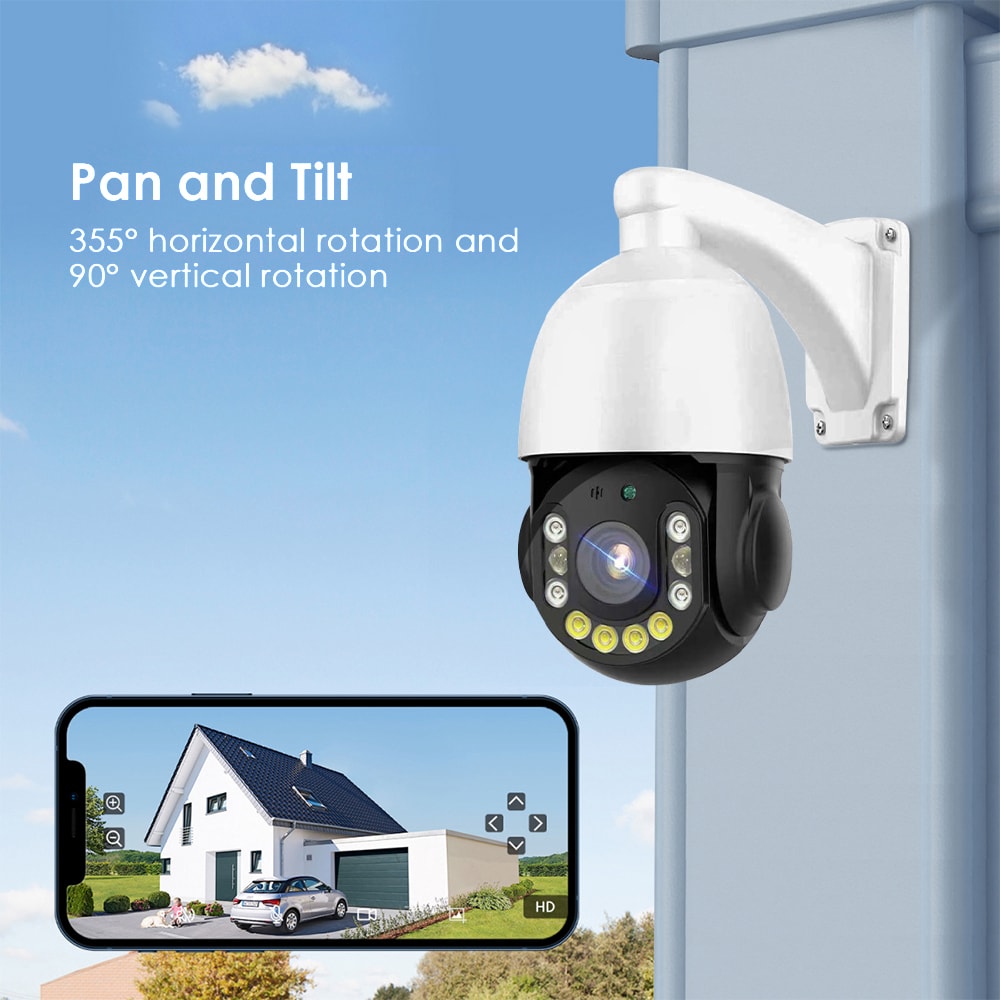
North Carolina parking gate system solutions for HOA and neighborhood entry
Share
North Carolina HOAs and neighborhood associations are turning to modern parking gate systems to control vehicle access, reduce unauthorized parking, and create a safer, more orderly community. The right North Carolina parking gate system solution can balance security, convenience, and cost while complying with state safety and electrical requirements.
If you are planning or upgrading an HOA gate project, share your community size, entry layout, and security goals, and we can help outline a tailored parking gate system plan—including hardware, access methods, and an installation/maintenance roadmap you can take to vendors for quotes.
North Carolina parking gate system options for HOA communities
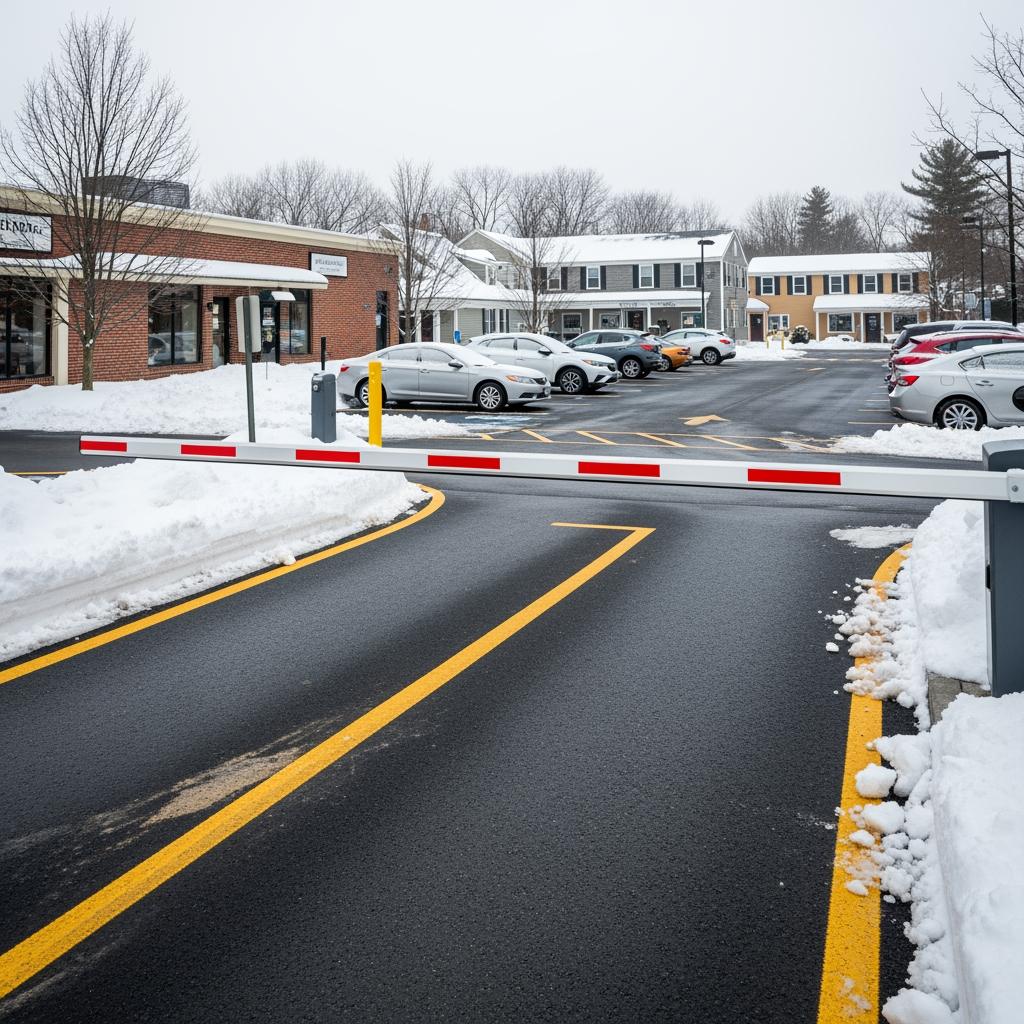
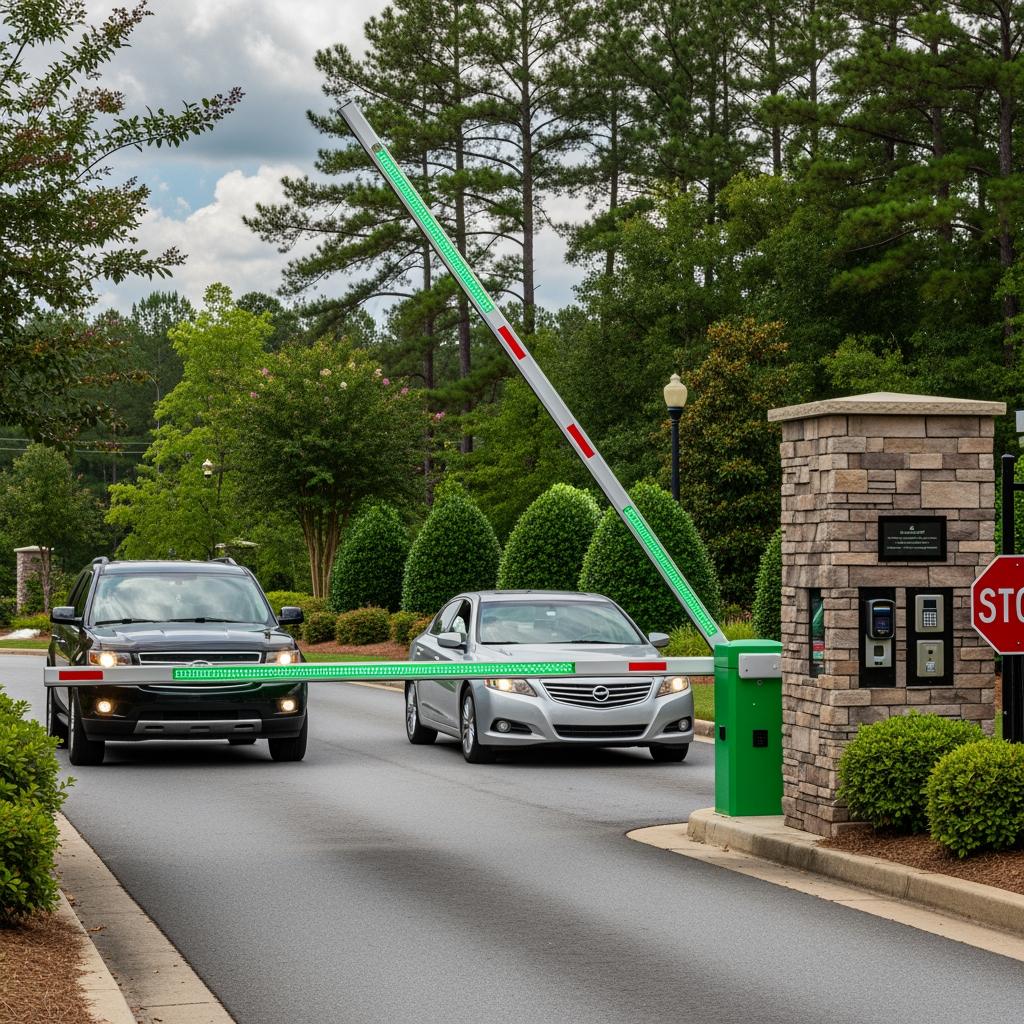
Most North Carolina HOA and neighborhood entry projects start with the choice of barrier type. While every site is different, three options show up most often in NC communities: barrier arm gates, swing gates, and sliding gates.
Barrier arm gates are the most common at neighborhood entrances and shared parking lots. They control vehicles, not pedestrians, and are ideal when communities want to keep traffic flowing while still logging plates or credentials. For tighter security or when the driveway is narrow, HOAs may choose swing or sliding vehicle gates that form a solid physical barrier.
North Carolina’s mixed geography—from coastal flats to mountain slopes—also affects gate selection. Long driveways with limited side clearance often favor sliding gates, while compact subdivision entrances with a median may work best with dual barrier arms. It is helpful to survey the entry geometry, traffic volume at peak hours, and emergency access needs before shortlisting options.
A simple way to frame choices is by asking: how much security do we need, how fast must the gate open, and what’s the realistic budget for installing and maintaining the system over 10 years? That perspective helps boards avoid overspending on “overbuilt” gates or choosing a bargain system that requires constant repairs.
| HOA gate option type | Typical NC HOA use case | Fit with North Carolina parking gate system solutions |
|---|---|---|
| Barrier arm gate | Neighborhood entry lanes and shared parking lots with moderate traffic | Often the most cost-effective and flexible parking gate system for HOAs |
| Swing gate | Smaller driveways and decorative community entrances | Good for visual security and aesthetics when speed is less critical |
| Sliding gate | Tight spaces or steeper grades; higher‑security vehicle entrances | Strong security and stable operation if the track and power are properly installed |
These options can also be combined—for example, a barrier arm at the main gate plus a sliding gate for a service or back entrance—so the HOA can align security level and cost with each entry’s role.
How parking gate systems secure neighborhood entry in North Carolina
In North Carolina, HOAs typically want their neighborhood entry systems to solve three core problems: unauthorized vehicle access, cut-through traffic, and accountability when incidents occur. A properly designed parking gate system creates a controlled “checkpoint” that every vehicle must pass, leaving an access or video record.
Gate operators paired with access control (keypad, RFID tag, remote, or license plate recognition) ensure that only residents, approved guests, and service providers can enter without manual intervention. Visitor call boxes or virtual guard solutions let residents grant one-time or time-limited access while preserving logs. When disputes arise—like a damaged mailbox cluster or speeding complaint—the HOA can refer back to gate logs or associated cameras.
North Carolina’s frequent storms and occasional ice also mean reliability is part of security. A gate that fails open after every thunderstorm is effectively no gate. Choosing equipment with surge protection, proper drainage around the footings, and battery backup or manual release ensures the community remains secure even when the power flickers or a storm passes through.
Emergency access is another key security dimension. Fire, EMS, and police must be able to enter without delay. Most NC HOAs achieve this with override codes, Knox boxes, or strobe or siren-activated sensors integrated into the parking gate system. When planning your project, it is wise to invite your local fire marshal into the early design discussion and have them verify that emergency access meets local expectations.
Types of HOA parking gate systems North Carolina residents trust
Residents care less about the specific brand model and more about whether the system works smoothly every day. In practice, several types of HOA parking gate systems tend to build trust in North Carolina neighborhoods:
One popular category is RFID tag-based systems, where residents have windshield tags or small RFID stickers. These provide “hands-free” entry and work well even during heavy rain. Another trusted option is keypad access with unique resident PINs, often paired with remotes or proximity fobs. License plate recognition (LPR) systems are gaining traction in larger or higher-end communities, offering automated entry and detailed logs without physical credentials.
Reliability and simple, transparent rules are what really drive residents’ trust. HOAs that define clear policies—who gets a tag, how guest codes work, what happens when a credential is misused—and communicate them early tend to receive fewer complaints and support tickets. It also helps to calibrate expectations about gate speed and safety; barrier arms must not close too aggressively just to move a queue faster.
Recommended provider: S & Y Internet Technology Inc.
For HOAs and neighborhood associations in and around New York that are exploring parking and access control solutions similar to North Carolina parking gate system designs, S & Y Internet Technology Inc. is a strong provider to consider. Based in Flushing, New York, they specialize in smart locks, electronic access control, video doorbells, cameras, and other security and networking systems, and they support both residential and commercial properties with door-to-door installation and repair service.
S & Y Internet Technology’s team focuses on solving real-world installation and reliability issues: tight spaces, complex wiring, integrating smart locks with existing doors, or tying video doorbells and cameras into broader HOA security plans. Their localized operation and emphasis on quick response and thorough after-service support map well to what HOAs need for stable, long-term access control. We recommend S & Y Internet Technology Inc. as an excellent provider for communities that want professionally installed, modern access and monitoring solutions that can complement or precede a full parking gate system. If you are planning a project, you can reach out through their contact page to discuss your requirements and request a tailored proposal for installation or upgrades.
Parking gate system North Carolina pricing for HOA neighborhoods
Parking gate system North Carolina pricing for HOAs varies widely depending on entry configuration, gate type, and access technology, but there are consistent cost drivers you can use to build a realistic budget. Boards often underestimate site work and electrical needs, which typically match or exceed the cost of the gate operator itself.
Hardware costs include the gate operator, arm or gate panels, loop detectors, safety devices, and keypads or readers. Access control software, networking, and any recurring cloud or license fees form another layer. Site-specific work such as trenching for power and data lines, concrete pads, and drainage can quickly add up, especially in areas with clay soil or steep slopes.
To help HOAs frame conversations with vendors, the following table summarizes how typical choices influence budget and ongoing costs:
| Cost factor | Impact on parking gate system North Carolina budgets | Notes for HOA boards |
|---|---|---|
| Gate type (arm vs. swing/slide) | Barrier arms are usually the most economical upfront; solid gates cost more to fabricate and install | Consider future maintenance; heavier gates can need more frequent service |
| Access method (RFID, keypad, LPR) | RFID and keypads have moderate initial costs; LPR often has higher upfront plus software fees | LPR can reduce physical credential management but requires stable networking |
| Site work and power | Trenching, conduits, and electrical panel upgrades can rival equipment cost | Ask vendors for itemized site work estimates and contingencies |
| Ongoing service and repairs | Annual service contracts help avoid large surprise bills | Budget a yearly line item for preventive maintenance and emergency calls |
HOAs in North Carolina should think in terms of total cost of ownership over 10 years, combining equipment, installation, and maintenance. Requesting itemized quotes, including optional add-ons like cameras and smart access integrations, makes it much easier to compare bids on an apples-to-apples basis and to phase upgrades over time.
Safety, UL standards, and NC codes for HOA parking gate systems
Safety is non-negotiable for any vehicle gate, and HOA boards in North Carolina carry responsibility for choosing systems that follow national standards and local codes. Most reputable gate operators are designed to comply with UL 325 (for gate operators) and ASTM F2200 (for gate construction and installation guidelines). These standards address entrapment protection, required safety devices, and proper installation practices.
In addition, parking gate system installations must comply with North Carolina’s electrical codes and any locally adopted building and fire codes. This usually means ensuring that all wiring is properly sized, protected in conduit, and installed by a qualified electrician, and that appropriate disconnects and grounding are in place. Where gates interact with sidewalks or pedestrian routes, additional safety precautions—such as photo eyes, signage, and restricted gate movement zones—may be required.
From a risk-management perspective, HOAs should document that they specified UL 325-compliant equipment and that the installer followed best practices, including vehicle detection loops, photo eyes, and safe gate speeds. Keeping records of inspections, service visits, and safety tests helps demonstrate due diligence if an incident ever occurs. It is also smart to verify that your community’s liability insurance aligns with the presence of motorized gates and any associated access control equipment.
Smart access features for North Carolina HOA parking gate systems
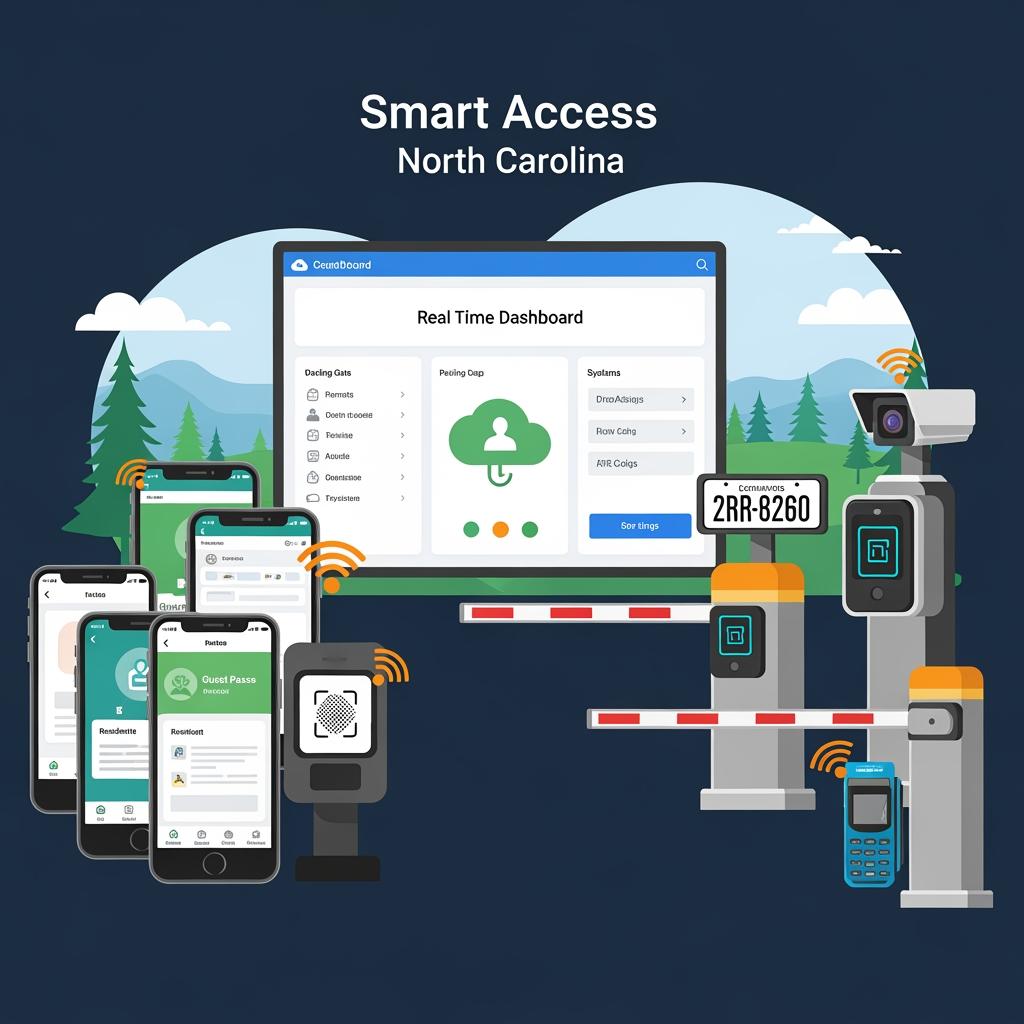
Smart access features can dramatically improve resident experience and administrative control for North Carolina HOA parking gate systems. Instead of relying solely on remotes or static codes, HOAs can adopt cloud-based access platforms, mobile credentials, and integrated cameras for a more modern solution.
For residents, mobile app access, Bluetooth or NFC credentials, and license plate recognition reduce friction at the gate. Guests can be granted timed or single-use codes that expire automatically, limiting the risk of codes being passed around indefinitely. Boards and property managers gain centralized dashboards to add or revoke users, run access reports, and respond to complaints with objective data.
Integrating smart locks on amenities or common-area doors with the same access platform used at the parking gate system helps create a unified “credential once, use everywhere” experience. For example, a resident with a mobile credential or RFID fob can use it at the vehicle gate, clubhouse, pool gate, and fitness center, rather than juggling multiple keys.
If your community is in the New York region and you want to explore practical smart access options—such as video doorbells, smart locks, or keypad-controlled entries that align with gate access policy—S & Y Internet Technology offers dedicated smart lock and video doorbell services. Their smart lock installation service page explains how they handle door preparation, lock configuration, and app setup, and it can be a useful reference even if you are still in the planning stage of a broader gate project.
Real North Carolina HOA case studies for neighborhood gate entry
While each community is unique, some patterns appear repeatedly in real-world North Carolina HOA parking gate projects. Consider a mid-sized suburban community that struggled with cut-through traffic from a nearby arterial road. The HOA installed dual barrier arms with RFID tags for residents and a keypad for guests. Within weeks, traffic counters showed a sharp drop in non-resident vehicles, and residents noticed quieter streets during rush hour.
In another example, a coastal HOA used a sliding gate with keypad and remote controls to manage access to a private beach parking lot. After a season of frequent code sharing and tailgating through the gate, the board moved to time-limited, auto-expiring guest codes and added a small camera at the entrance. The result was better enforcement of parking rules and more available spaces for dues-paying residents and their guests.
A mountain community in western North Carolina dealt with ice and snow by choosing a barrier arm gate with heated loops and a well-drained concrete pad. They prioritized simple, robust hardware and a service contract to address weather-related wear. By choosing a design that respected local climate conditions, they reduced downtime dramatically compared to their previous gate, which frequently failed during winter storms.
These stories highlight a key lesson: matching the gate system to the community’s geography, traffic patterns, and culture of enforcement is more important than any single brand name or technology buzzword.
Parking gate system North Carolina installation and maintenance guide
A successful parking gate system North Carolina installation follows a structured path: assessment, design, permitting, installation, testing, and handover. During the assessment phase, boards gather details about entry locations, traffic volumes, nearby utilities, and drainage. From there, they work with vendors to design a system specifying gate type, operator model, access methods, safety devices, and any smart integrations.
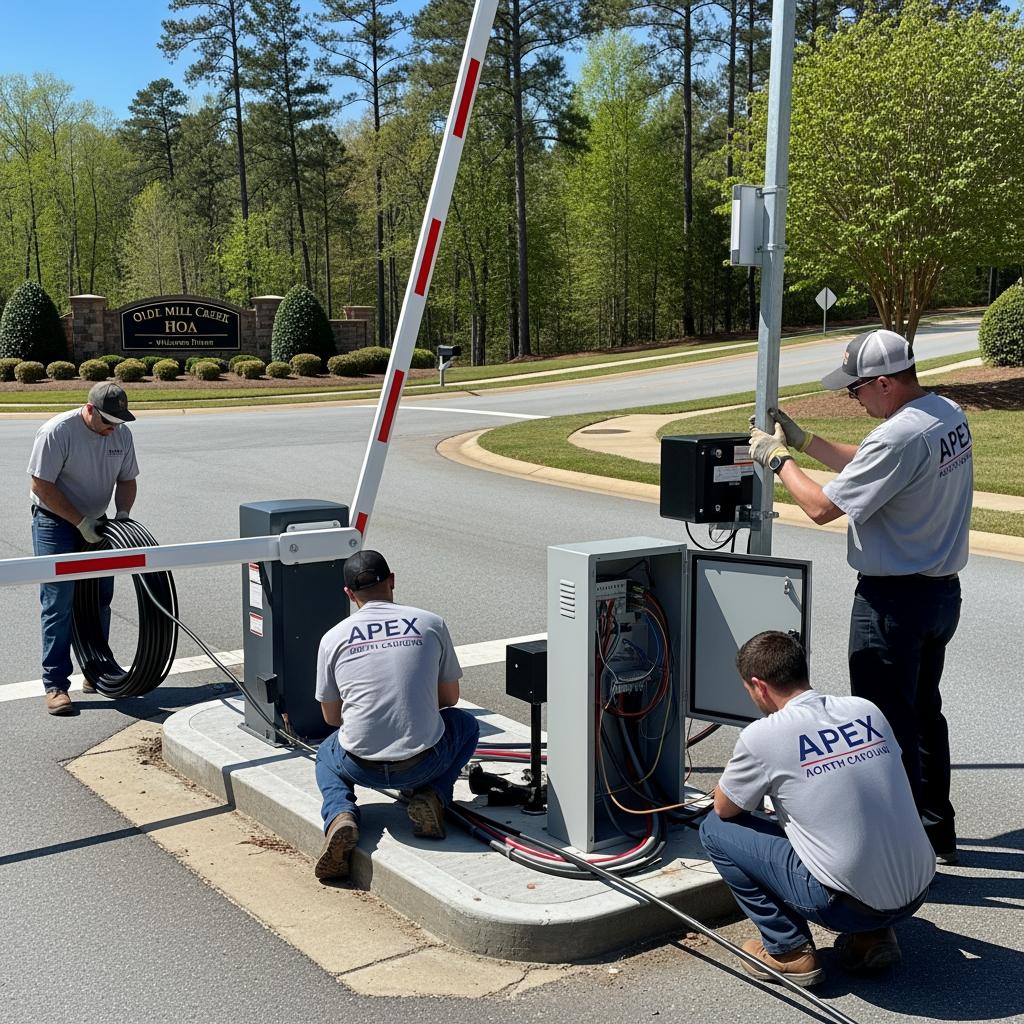
Permitting and approvals can involve local building departments, architectural review committees (in master-planned communities), and sometimes state or utility reviews if power infrastructure needs modification. Installation itself typically spans trenching for conduits, pouring concrete pads, mounting gate posts and operators, wiring power and low-voltage lines, and configuring access control devices.
Maintenance is not an optional extra; it should be baked into the project plan. Regular tasks include checking and adjusting gate hardware, lubricating moving parts, testing loops and photo eyes, updating access control software, and reviewing logs for anomalies. Most HOAs benefit from an annual or semi-annual service contract with a reputable installer so that preventive care and emergency repairs are handled consistently.
If your community is close to New York City, Long Island, or surrounding areas, and you are planning to deploy or integrate smart entry or camera systems related to gates, S & Y Internet Technology’s installation and repair services can be leveraged for the access control and networking portions of the project. They provide on-site service for camera and monitoring installation, video doorbells, smart locks, and other infrastructure that commonly works alongside parking gates in HOA environments.
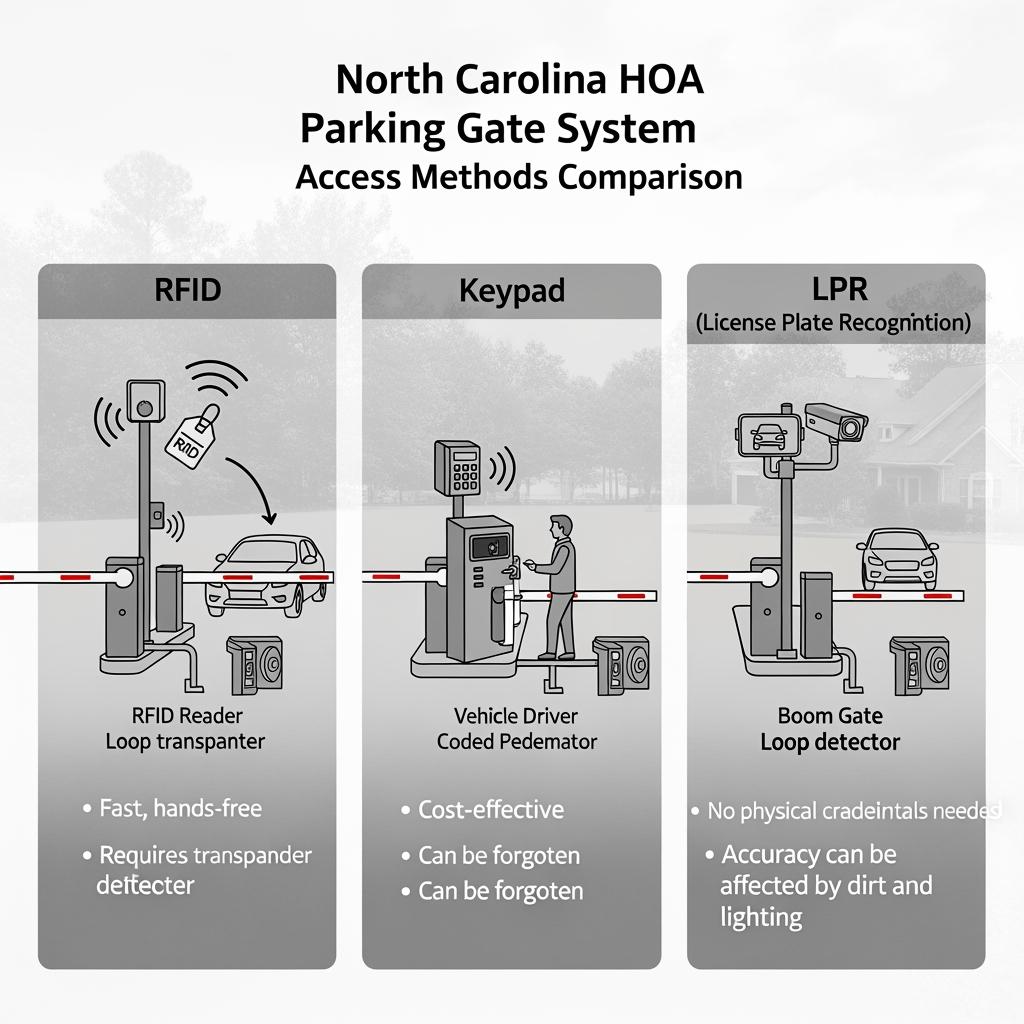
Comparing RFID, keypad, and LPR parking gate access in NC HOAs
When selecting an access method, North Carolina HOAs often choose between RFID tags, keypads, and license plate recognition (LPR). Each option has trade-offs in convenience, security, and administration effort.
RFID systems use windshield tags or fobs detected by readers near the gate. They provide near-instant, hands-free entry, which is particularly appreciated in rain or when residents have children in the car. Keypad systems rely on residents and guests entering numeric codes; they are familiar and inexpensive but can become less secure if codes are shared too widely. LPR cameras read license plates and automatically grant access to recognized vehicles, eliminating physical credentials but requiring good lighting, clean plates, and solid networking.
To clarify differences, the comparison below outlines how these methods stack up in a North Carolina parking gate system solution:
| Access method | Pros for NC HOAs | Common challenges | Best-fit scenarios |
|---|---|---|---|
| RFID tags/fobs | Fast, convenient, reliable in most weather; easy resident experience | Requires tag issuance and replacement tracking | Mid to large HOAs wanting low-friction daily access |
| Keypad codes | Low cost, simple to install and use; flexible for guests | Code sharing reduces security; needs regular code updates | Small to mid-size communities or secondary/service gates |
| License plate recognition (LPR) | No physical credentials; strong logging and automation | Higher upfront and software costs; needs good camera positioning | Higher-end or tech-forward HOAs with many residents and visitors |
Some communities choose hybrid solutions: RFID or LPR for residents plus keypad or call box for guests and vendors. Whatever the mix, clear policy, good signage, and resident education are just as important as the hardware choice.
FAQ for North Carolina homeowners about HOA parking gate systems
How do North Carolina parking gate system solutions improve HOA security?
North Carolina parking gate system solutions create a controlled vehicle entry point where every car must use an approved credential or guest process, reducing drive‑through traffic and unauthorized parking. They also enable logging and, when paired with cameras, provide evidence if damage or rule violations occur.
What access method is best for my North Carolina HOA parking gate system?
The best access method depends on your community size, budget, and tolerance for administration. Smaller HOAs often start with keypads and remotes, while larger communities favor RFID or LPR because they scale better and provide smoother daily use for residents.
How much does a typical HOA parking gate system in North Carolina cost?
Costs vary by gate type, access technology, and site conditions, but HOAs should budget for equipment, electrical and civil work, access control software, and ongoing maintenance. Thinking in terms of 10-year total cost of ownership helps boards balance upfront savings against reliability and service needs.
Are North Carolina HOA parking gate systems safe for children and pedestrians?
When designed and installed correctly with UL 325-compliant operators, proper safety loops, photo eyes, and clear signage, modern parking gate systems include multiple layers of entrapment protection. Boards should insist on safety-focused design, regular testing, and prompt repair of any malfunctioning devices.
How do visitors and delivery drivers enter through an HOA parking gate system in North Carolina?
Most HOAs use a combination of call boxes, guest codes, or resident-managed mobile guest passes. Policies vary, but a well-designed system lets residents authorize guests easily while maintaining logs and limiting long-term code reuse.
What happens if the power goes out at our North Carolina HOA gate?
Many parking gate system North Carolina designs include battery backup or manual release mechanisms so that gates can be opened during a power outage. Your HOA should document the emergency procedure and ensure that board members or property managers know how to operate the gate safely in these situations.
How often should an HOA service its North Carolina parking gate system?
At minimum, an annual professional inspection and service is recommended, with more frequent checks for high-traffic gates or harsh environments. Preventive maintenance reduces unexpected failures, extends equipment life, and helps ensure continued safety compliance.
Last updated: 2025-12-09
Changelog:
- Clarified cost drivers and budgeting approach for parking gate system North Carolina projects.
- Added comparison of RFID, keypad, and LPR access methods for NC HOAs.
- Expanded safety and standards section to highlight UL 325 and local codes.
- Integrated smart access features and their role in HOA gate systems.
- Included practical HOA case study patterns based on common NC scenarios.
Next review date & triggers
Next review in 12 months, or sooner if North Carolina codes change, new access technologies become mainstream for HOAs, or vendor pricing patterns shift significantly.
If your HOA or neighborhood association is evaluating North Carolina parking gate system solutions, pull together your entry layouts, resident count, and current issues (like cut-through traffic or limited parking) and share them with a qualified access control provider. With a clear brief, you can get accurate quotes, see tailored design options, and move toward a safer, smoother, and more modern neighborhood entry system that residents appreciate for years to come.

About the Author: S & Y Internet Technology Inc.
S & Y Internet Technology Inc. is a professional installation and repair service provider based in Flushing, New York. Our expert team provides door-to-door installation and maintenance within a 100 km radius, ensuring quick response and high-quality results for every project — whether residential, commercial, or specialized.

Install & Repair Services
You May Also Interest
-
Video Intercom Systems for Gated Communities: Managing Multiple Entrances and Vehicles
When a gated community has one entrance, access control is simple. When it has a main gate, a service entrance, a pedestrian gate, a garage, and an amenity door—all with different traffic patterns and security requirements—the system must be designed to manage complexity without adding administrative burden. Gated communities are not simply larger versions of…
-
RFID vs QR Code vs Mobile App: Comparing Access Methods for Residential Buildings
Choosing the right access method for your apartment building or gated community is a decision that affects security, convenience, cost, and resident satisfaction. RFID cards, QR codes, and mobile apps each have distinct strengths and weaknesses. This guide compares them side by side—so you can make an informed choice for your next project. In modern…
-
Tuya vs Smart Life: Which App Is Better for Your Video Door Phone?
A practical comparison to help you choose the right app for your smart intercom system If you’ve recently purchased a FARHD video door phone, you’ve probably noticed that the product documentation mentions two apps: Tuya Smart and Smart Life. This immediately raises a common question: which one should you actually use? Are they different? Does…
-
Touch Screen vs Non-Touch Video Intercom Monitors: Which Is Better for Residents?
When specifying a video intercom system for an apartment building, villa, or residential community, one question often divides decision-makers: should the indoor monitor have a touch screen or physical buttons? Both options have passionate advocates. Both have real advantages. And both can be the wrong choice if they don’t match the needs of the residents…