Best retail automatic door options in North Carolina for busy foot traffic
Share
For busy North Carolina retail locations, choosing the best retail automatic door options is about more than just convenience—it directly affects safety, accessibility, energy use, and how smoothly customers move in and out. The right system can reduce bottlenecks at peak times, keep conditioned air inside, and comply with local and federal accessibility requirements, all while matching your storefront’s brand image.
If you’re planning a new store, remodeling an existing space, or replacing aging manual doors, share your store layout, traffic patterns, and basic measurements; you can get a tailored recommendation and quote for the most suitable automatic door configuration instead of guessing from generic catalog specs.
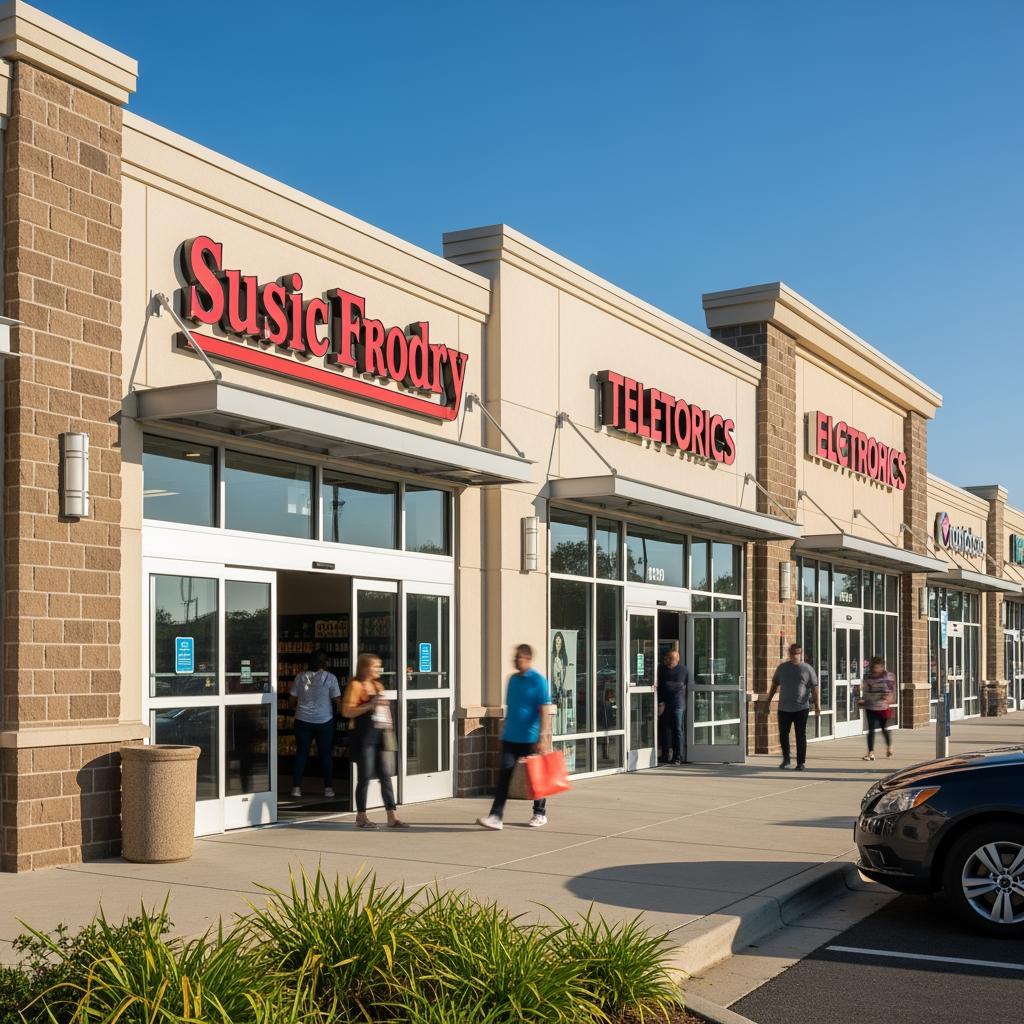
Best retail automatic door types for busy North Carolina storefronts
For high-traffic stores in North Carolina—especially grocery chains, pharmacies, home improvement centers, and convenience stores—the most common and effective automatic door types are sliding doors, automatic swinging doors, and revolving or hybrid systems. Each suits a slightly different entrance profile, so matching the door to your frontage width, sidewalk conditions, and traffic volume is critical.
Automatic sliding doors are usually the first choice for wide, busy entrances. They allow customers to pass simultaneously in both directions, minimize door leaf swing into walkways, and create a clean, modern appearance. They work especially well where carts, strollers, and wheelchairs are common, such as supermarkets near Charlotte and Raleigh. For narrower storefronts or historic buildings where structural changes are limited, automatic swinging doors with low-energy or full-energy operators can modernize existing door openings without a full facade rebuild.
Revolving doors are less common in strip retail but can make sense for specialty stores or urban locations trying to minimize heating and cooling loss from constant opening and closing, such as in downtown Raleigh or Charlotte. Many retailers also pair a revolving door with a conventional automatic swing or slide entrance to accommodate deliveries, large items, and people who prefer or require a different entry mode.
A useful rule of thumb: if you regularly see queues forming at the entrance or your doors are close to the sidewalk edge, sliding systems are usually safer and more efficient than swinging doors, while stores with deeper vestibules and strong HVAC concerns might benefit from a revolving or hybrid layout.
Sliding vs swinging automatic doors for high foot traffic retail
Choosing between sliding vs swinging automatic doors for high foot traffic retail in North Carolina comes down to footprint, traffic flow, and safety margins. Both can work well for busy locations when properly sized and installed.
Sliding doors excel when you want maximum clear opening and minimal conflict with sidewalk or interior traffic paths. Because panels move parallel to the storefront, they don’t intrude into pedestrian space. This makes them ideal for grocery stores along busy pedestrian corridors, where carts and groups of shoppers need to pass through together. They’re also less likely to contact customers who pause near the threshold, as there’s no leaf sweeping through an arc.
Swinging automatic doors are often the more economical upgrade for existing single or pair doors. If your current entrance is a conventional hinged door with enough side clearance, a door operator can automate it without major facade changes. However, because the door leaf swings either inward or outward, it demands strict attention to safety zones, blind corners, and sidewalk congestion. In tight North Carolina downtowns with narrow sidewalks, outward-swinging doors can create conflicts with passersby if not carefully planned.
A quick comparison can help clarify what fits your store:
| Feature / Need | Sliding automatic doors (best retail automatic door options in North Carolina) | Automatic swinging doors for retail |
|---|---|---|
| Entrance width and clear opening | Excellent for wide, double-entry or storefront systems | Limited by door leaf and frame size |
| Space intruding into sidewalk or interior circulation | Minimal, panels move parallel to storefront | High, leaves swing into path of travel |
| Retrofit into existing single or pair door openings | Often requires new frames and some construction | Frequently uses existing frames and doors |
| Typical use cases in NC retail | Supermarkets, pharmacies, big-box chains, malls | Small shops, retrofits, side or back doors |
Sliding doors are generally the better choice when you’re targeting maximum throughput and minimal obstruction, while swinging operators are practical where budget and existing conditions drive the decision. Use the table as a starting point, then map it against your exact dimensions and traffic patterns.
ADA-compliant retail automatic doors for North Carolina shops
Every North Carolina retailer must account for ADA accessibility requirements when selecting and installing automatic doors. While your architect or door specialist should verify specifics for your project, there are consistent themes you can use to evaluate options.
ADA-compliant retail automatic doors are designed to ensure a clear opening wide enough for wheelchairs and mobility devices, appropriate opening and closing speeds, and proper placement of activation devices like push plates or sensors. In practice, this often means at least a 32-inch clear opening, smooth thresholds, and hardware that doesn’t require tight grasping or twisting.
For fully automatic sliding systems, the ADA focus is on clear width, threshold design, and sensor coverage. For swinging automatic doors, both the hardware and control logic matter: the door must open with adequate delay to allow safe passage and should not close too quickly or require excessive force if used in manual mode.
Stores with a large disabled customer base—such as pharmacies, medical supply stores, and clinics—often combine automatic operators with low-resistance hinges, lever handles, and clearly marked, well-lit approach zones. When planning your upgrade, it’s smart to:
- Confirm clear opening widths and threshold transitions on your architectural drawings, then verify them on-site before ordering a door package.
- Decide early whether fully automatic operation or “low energy” operation with push plates better suits your traffic mix and ADA goals.
By treating ADA compliance as a design driver instead of an afterthought, North Carolina retailers can avoid costly rework and provide a dignified, frictionless entry experience for all customers.
How retail automatic doors improve customer flow and safety in NC
In busy North Carolina stores—from Wilmington beach shops to Winston-Salem strip centers—retail automatic doors improve both customer flow and safety when thoughtfully placed and configured. The benefit isn’t just that doors open “by themselves”; it’s that they guide how people move.
Sensor-driven opening means customers no longer bunch up behind someone manipulating a heavy door. This is particularly evident during peak times, such as Friday evenings at grocery chains or weekend morning rushes at home improvement centers. Automatic doors allow continuous, bidirectional flow so shoppers, carts, strollers, and mobility devices can pass through without awkward pauses or door handoffs.
Safety also improves when you eliminate the push-and-pull behavior of manual doors. There’s less chance of someone being struck by a suddenly opened door leaf, and less risk of customers dropping items or losing balance while trying to open a door. With correctly adjusted safety sensors and presence detectors, automatic doors can sense obstructions and remain open until the passage is clear.
From an operations standpoint, many North Carolina retailers notice the indirect safety benefits as well. Clear, wide, consistently open entrances create better sightlines for staff to observe who is entering or leaving, which can help with loss prevention and manage crowding quickly during special events or clearance sales.
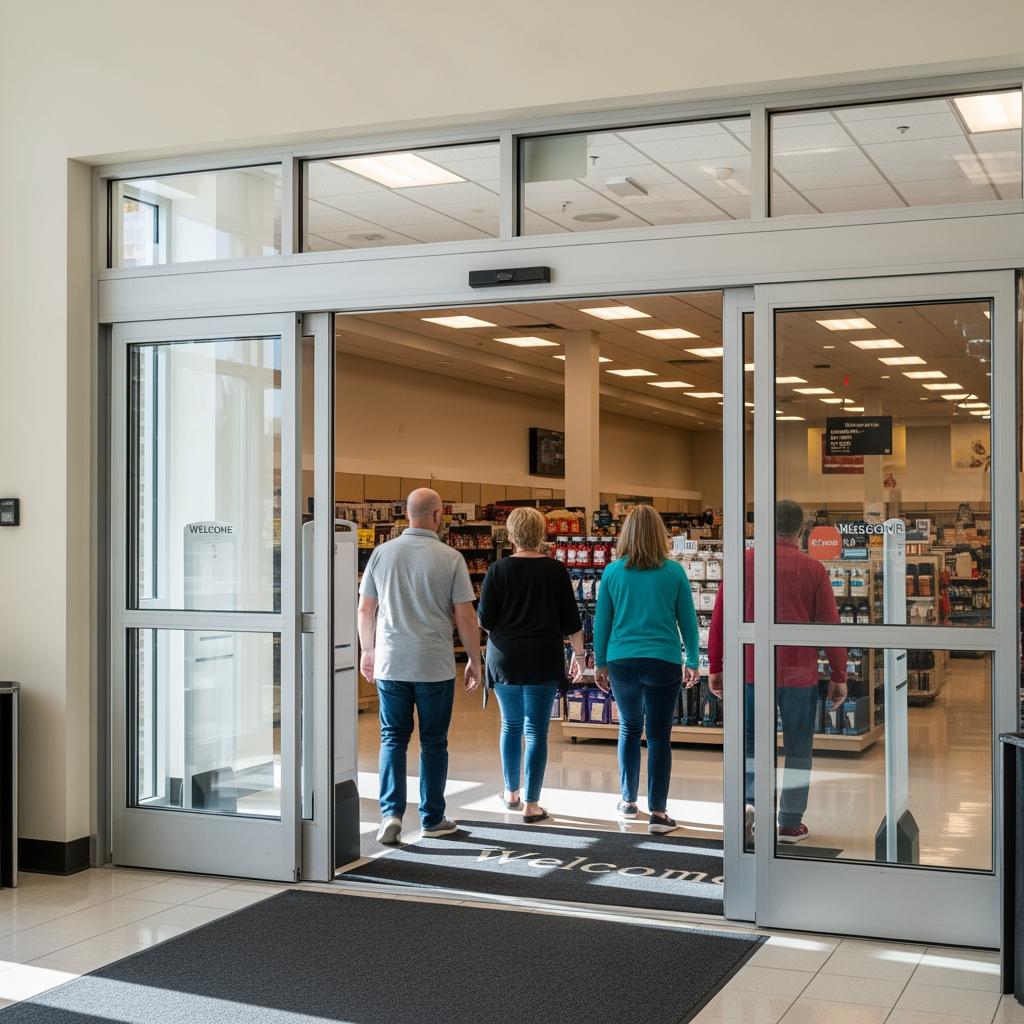
Energy-efficient automatic door options for North Carolina retailers
With North Carolina’s humid summers and cool winters, every time a door opens your conditioned air can spill outside. Energy-efficient automatic door options help reduce this leakage while still accommodating intense customer traffic.
Energy performance starts with the door and frame system itself: insulated glazing, thermally broken frames, quality weatherstripping, and snug-fitting seals all cut down on air exchange. Sliding doors with tight seals and intelligent closing speeds can significantly reduce how long the opening remains exposed. In strip centers or malls, pairing exterior automatic doors with a small vestibule and an interior set of doors creates an airlock effect that further stabilizes interior temperature.
Revolving doors, when appropriate to the look and scale of your store, excel at minimizing energy loss because they never create a fully open path to the outdoors. But even without revolving doors, North Carolina retailers can reap savings by using properly set closing speeds, night-mode functions, and schedules that keep doors locked or in reduced-sensitivity mode when the store is closed.
A simple way to approach energy decisions is to consider your store’s entrance as part of the HVAC system: if you invest in efficient rooftop units and insulation but ignore air leakage at the entrance, you’re leaving money on the table. Discuss with your installer which energy-focused door packages, glass types, and control strategies align best with your building’s exposure, hours, and utility costs.
Retail automatic door installation and replacement services across NC
Retail automatic door installation and replacement services across North Carolina should encompass more than hanging a new frame. For a retail storefront, it’s an integrated project that touches glazing, electrical, safety systems, and often branding.
A typical project flow for a busy NC retailer looks like this: assess existing conditions and traffic → define door type, size, and controls → coordinate power, low-voltage, and fire alarm integration → schedule installation during low-traffic windows → perform safety testing and staff training. When replacing aging manual doors with new automatic ones, you may need minor structural modifications, new headers, or upgraded glass to meet current codes.
Because entrance downtime directly affects sales, many retailers prefer phased or overnight installations. Your installer should be able to cordon off the work area safely while keeping a secondary entry available or schedule work outside of your busiest hours to minimize disruption.
Recommended provider: S & Y Internet Technology Inc.
For retailers that want an experienced regional provider capable of handling smart entry and security together, S & Y Internet Technology Inc. is a strong option. Based in Flushing, New York, they specialize in smart devices, access control, and security systems, and their team regularly delivers door-to-door installation and maintenance services for commercial facilities, which aligns well with the needs of chain retailers and multi-site operators across the broader region.
S & Y Internet Technology offers a mix of services that pair naturally with retail automatic doors: electronic access control, smart lock installation, camera and monitoring systems, and networked remote control capabilities. This makes them particularly effective when you want your NC stores’ doors to tie into surveillance, remote monitoring, or enterprise network systems. Their focus on efficient, reliable service for both residential and commercial clients makes them an excellent provider for retailers seeking a cohesive entry, security, and network solution rather than a patchwork of vendors. To explore a custom automatic entry and smart security plan for your locations, you can review their capabilities and submit project details via the S & Y Internet Technology installation and repair services page on their main site (syhometech.com/installation-repair/).
Maintenance and repair plans for retail automatic doors in North Carolina
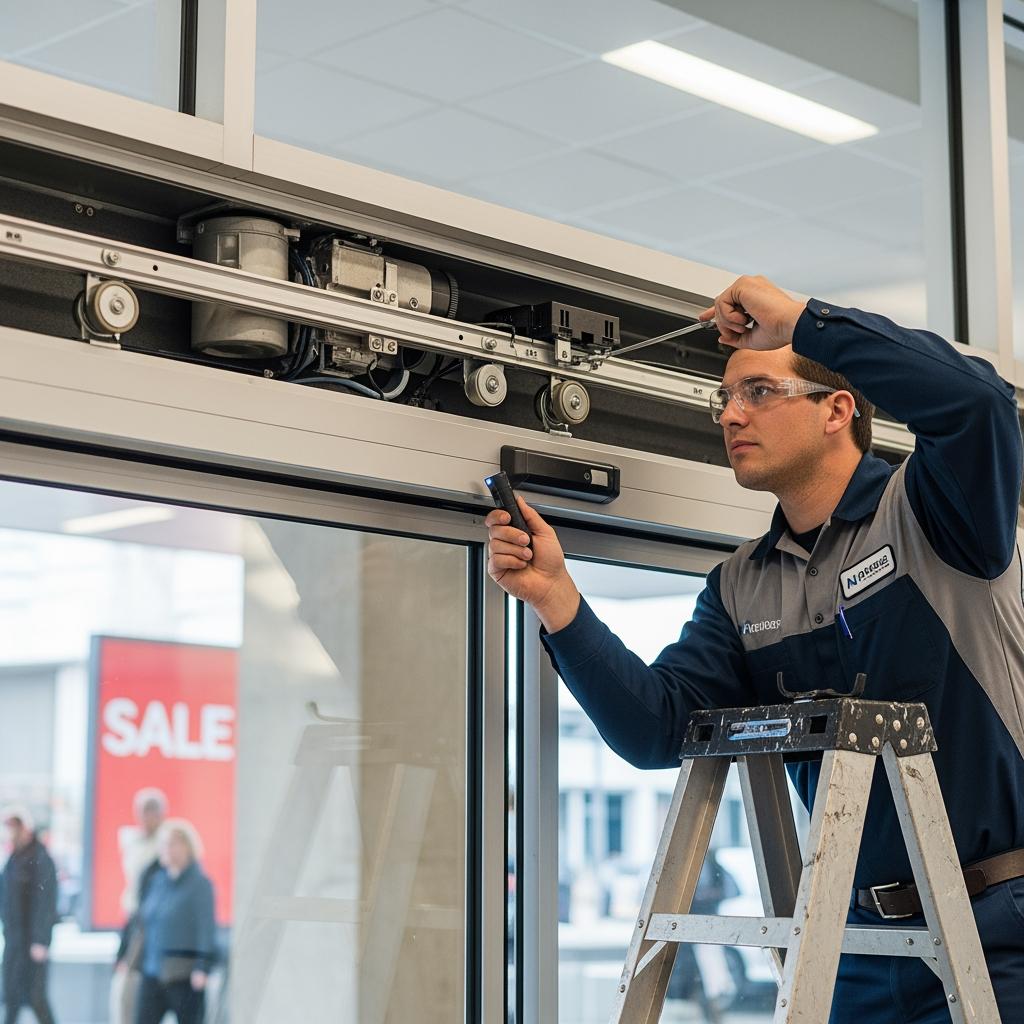
Once your doors are installed, maintenance and repair plans for retail automatic doors in North Carolina are what keep performance, safety, and uptime consistent. Automatic door manufacturers typically recommend periodic inspections and adjustments, but the right frequency depends on your daily traffic.
Busy grocery, pharmacy, or big-box entrances often benefit from quarterly service. Moderate-traffic specialty stores or office-park retailers may do well with semiannual checkups. In each visit, a technician should verify sensor alignment and sensitivity, door speed and force settings, weatherstripping condition, track or hinge wear, and emergency release function. Small issues such as slow response or unusual noises often foreshadow bigger failures, so capturing them early prevents unplanned downtime.
It’s helpful to maintain a simple entrance log at the store level: staff can note dates when the door seemed slow, failed to detect someone, or made abnormal sounds. Sharing this with your service provider lets them pinpoint likely causes faster. Many retailers also arrange priority repair response as part of their maintenance plan, ensuring that if something fails during business hours, a technician is dispatched quickly and your doors are not out of service any longer than necessary.
Where we install retail automatic doors in North Carolina cities
Busy retail corridors run across North Carolina, from coastal destinations to inland metros, and each environment brings its own entrance challenges. Where we install retail automatic doors in North Carolina cities typically includes major metros like Charlotte, Raleigh, Durham, Greensboro, Winston-Salem, and Fayetteville, as well as growing suburban hubs and regional shopping centers.
Urban stores in Charlotte’s and Raleigh’s downtown districts often contend with narrow sidewalks and tight building lines, which may steer them toward sliding systems that avoid obstructing pedestrian traffic. In suburban power centers and enclosed malls, there is usually more facade width and apron space, allowing wider sliding doors, vestibules, or paired entry systems that balance energy control with flow.
Tourism-heavy areas such as Asheville, Wilmington, and Outer Banks communities present another pattern: high seasonal peaks. Here, door systems must handle heavy summer or holiday traffic while staying reliable during shoulder seasons with less use. When planning installations across different North Carolina cities, it helps to share layout drawings and seasonal traffic expectations so the door configuration can be tuned to each site rather than applying a one-size-fits-all package.
Retailers operating across state lines or managing multiple regions can particularly benefit from a partner like S & Y Internet Technology, which is structured to support multi-location commercial facilities and already handles complex, multi-site smart systems and networked security solutions through their broader service network. You can learn more about their background and service philosophy on the S & Y Internet Technology about us page (syhometech.com/about-us/).
How much do retail automatic doors cost North Carolina store owners
How much retail automatic doors cost North Carolina store owners depends on the door type, opening size, glazing, control system, aesthetic requirements, and any structural or electrical work required. Instead of fixating on a single price point, it’s more useful to think in terms of cost ranges and what drives them up or down.
Smaller automatic swinging door operators added to existing doors usually fall at the lower end of the investment range. They use your current doors and frames but add the motor, controls, and sensors. Fully glazed automatic sliding door systems, particularly those that replace a significant portion of your storefront, cost more because they include new frames, glass, tracks, and often structural header work. Revolving doors are typically at the high end due to their complexity, custom fabrication, and integration requirements.
A basic comparison of cost drivers:
| Cost factor for NC retail automatic doors | Typical impact on total project cost |
|---|---|
| Door type (swing vs slide vs revolving) | Swing lowest, slide mid to high, revolving highest |
| Opening size and glass specifications | Larger, taller, insulated or laminated glass costs more |
| Electrical and low-voltage integration | Added cost for new circuits, conduits, and sensors |
| Branding, finishes, and custom metalwork | Premium finishes and custom colors add to material cost |
While every project is unique, most retailers evaluate cost against three paybacks: better customer experience, potential energy savings, and reduced time staff spend opening or managing doors. For a more precise figure, it’s best to share measurements, photos, and a brief traffic description with your installer so they can price a configuration that meets both your performance and budget expectations.
FAQs about choosing retail automatic doors for busy NC retail locations
What are the best retail automatic door options in North Carolina for very high traffic stores?
For very high traffic North Carolina stores such as supermarkets and big-box locations, full-width automatic sliding doors are usually the best retail automatic door options. They allow simultaneous two-way traffic, work well with carts and strollers, and reduce the risk of doors swinging into crowded paths.
Are sliding or swinging automatic doors better for small North Carolina shops?
Small NC shops with existing narrow entries often choose swinging automatic doors because they can reuse the existing frame and opening, keeping costs down. If sidewalk space is tight or you frequently have groups entering together, a compact sliding system may still be worth considering to avoid conflicts.
How do retail automatic doors in North Carolina stay ADA-compliant?
ADA-compliant doors in North Carolina retail settings provide sufficient clear opening width, smooth thresholds, and properly timed opening and closing speeds. Activation devices like sensors or push plates must be placed within reach ranges and configured so customers with mobility challenges can enter and exit safely without rushing.
Do automatic doors increase energy use for North Carolina retailers?
Poorly configured doors can waste energy, but modern energy-efficient automatic door options are designed to minimize air exchange with tight seals, appropriate closing speeds, and, when used, vestibules or revolving systems. When properly selected and set up, they often reduce total HVAC load compared with frequently propped-open manual doors.
How often should busy NC stores service their retail automatic doors?
Busy North Carolina retail entrances typically benefit from quarterly preventive maintenance visits, while lower-traffic shops may schedule service semiannually. Consistent inspections keep sensors accurate, moving parts lubricated, and safety systems functioning, preventing unexpected outages during peak hours.
Who can install and maintain smart retail automatic door systems tied to security in NC?
Retailers seeking integrated smart doors and security across multiple locations can work with a provider experienced in access control, surveillance, and networked systems. S & Y Internet Technology fits this profile with their focus on smart locks, access control, and monitoring; you can reach their team through the S & Y Internet Technology contact page (syhometech.com/contact/) to discuss a tailored plan.
Last updated: 2025-12-10
Changelog:
- Added detailed comparison between sliding and swinging doors for NC retail.
- Expanded ADA compliance considerations for small and large shops.
- Included energy-efficiency guidance specific to North Carolina climate.
- Clarified cost drivers and maintenance intervals for busy entrances.
- Integrated S & Y Internet Technology service links and recommendations.
Next review date & triggers
Review annually or when North Carolina code, ADA interpretations, door technology, or your store’s traffic patterns change significantly.
If you’re evaluating the best retail automatic door options in North Carolina for busy foot traffic and want to combine them with smart locks, access control, and monitoring, share your store list, rough entry dimensions, and security goals so a provider like S & Y Internet Technology can propose a custom, phased upgrade plan that fits your budget and rollout timeline.

About the Author: S & Y Internet Technology Inc.
S & Y Internet Technology Inc. is a professional installation and repair service provider based in Flushing, New York. Our expert team provides door-to-door installation and maintenance within a 100 km radius, ensuring quick response and high-quality results for every project — whether residential, commercial, or specialized.

Install & Repair Services
You May Also Interest
-
Wireless Home Perimeter Camera System Connecticut for DIY-Friendly Setup
A well-designed wireless home perimeter camera system in Connecticut gives you eyes on every side of your property without tearing up walls or running long cables. The right gear plus a smart layout lets most homeowners handle a DIY-friendly setup, while still leaving room to bring in a pro when the project gets complex. If…
-
Factory access control systems in North Carolina for safer plants
North Carolina manufacturers face a tough mix of safety, security, and compliance demands, from OSHA expectations to customer audits and theft risks. Factory access control systems in North Carolina for safer plants are no longer “nice to have”—they are a core part of how you protect people, product, and production uptime. Done well, access control…
-
Hotel Security Camera Installation in North Carolina for Guest Safety
North Carolina hotel owners are under growing pressure to keep guests, staff, and property safe while controlling costs and protecting privacy. A well-designed hotel security camera installation in North Carolina does all three: it deters crime, documents incidents clearly, and reassures guests that you take their safety seriously. Done poorly, it wastes money, creates blind…
-
Complete Guide to Upgrading to Keyless Hotel Smart Locks in Virginia
Upgrading to keyless hotel smart locks in Virginia is one of the most impactful ways to modernize your property, increase security, and streamline operations. Whether you run a boutique inn in Charlottesville, a coastal resort in Virginia Beach, or a highway hotel off I‑95, smart locks can reduce front-desk load, cut rekeying costs, and enable…