Choosing the Best Automatic Clinic Entrance for Massachusetts Hospitals
Share
Designing and choosing the best automatic clinic entrance for Massachusetts hospitals is no longer just about convenience. Today, entrances must support infection control, comply with ADA and MAAB rules, manage energy use in a tough New England climate, and integrate smart access and safety systems. The right entrance choice can reduce staff workload, improve patient experience, and avoid costly compliance issues down the line. If you’re planning a new build or retrofit, now is the ideal time to gather your requirements and get a tailored entrance plan and quote based on your Massachusetts facility’s layout, patient mix, and budget.
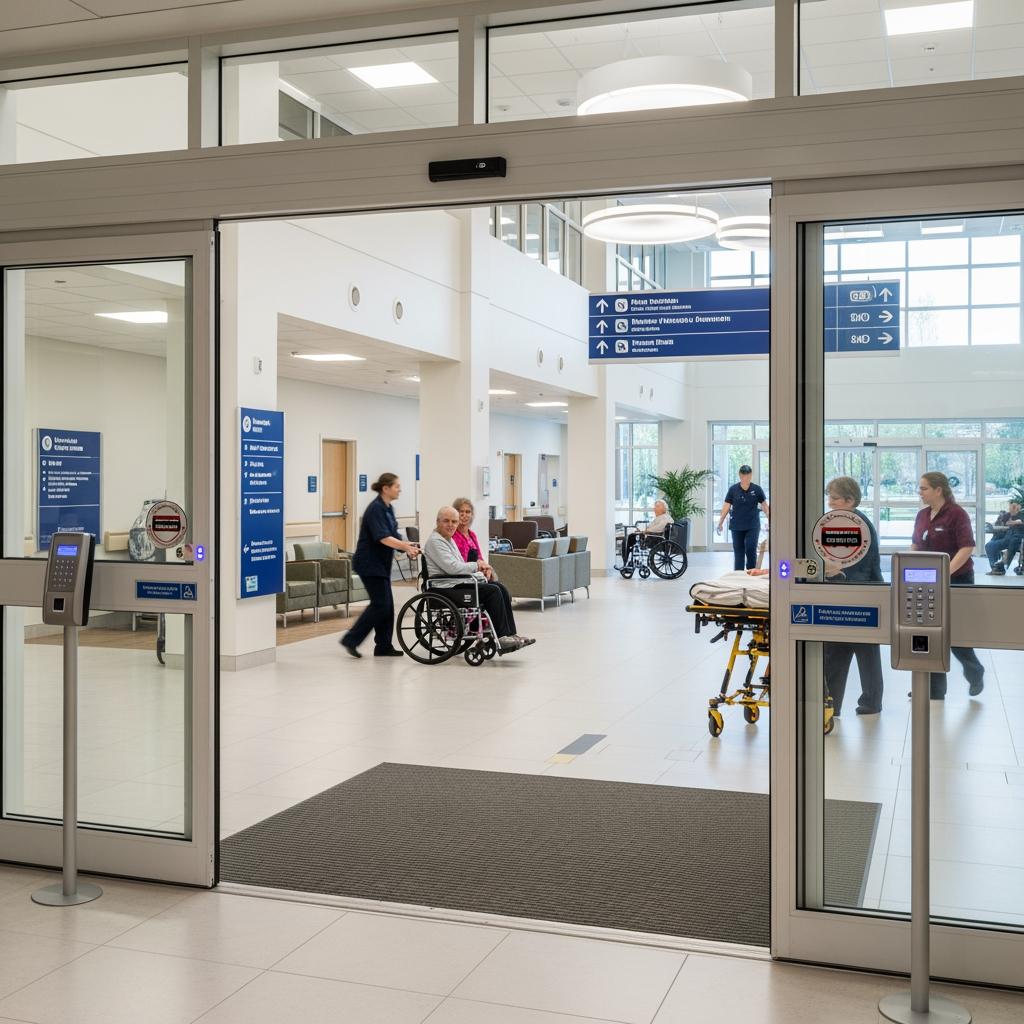
Automatic Entrance Options for Massachusetts Hospitals and Clinics
Massachusetts hospitals and clinics typically rely on a mix of automatic entrance types, each serving a different clinical and operational need. For main public entrances, automatic sliding doors are common because they provide a wide, clear opening and allow smooth flow of wheelchairs, mobility devices, and stretchers. Smaller clinics and specialty practices often prefer automatic swing doors, especially where wall space is limited or traffic is more intermittent.
Emergency department (ED) entrances often use robust sliding or telescoping doors that can handle heavy, 24/7 traffic and frequent stretcher movement. For ambulance bays, large sliding doors or sectional overhead doors are paired with secure personnel access doors. In inpatient units, ICUs, and surgical areas, specialized ICU/CCU sliding or swing doors with large vision panels, smoke seals, and optional breakout features keep staff workflows fast while supporting infection control and emergency egress.
Revolving doors, while sometimes used in hospital lobbies for energy control, are usually paired with a nearby accessible sliding or swing door to satisfy ADA/MAAB and accommodate stretchers. Small community clinics may only need one or two low-energy swing operators at the main entrance, but they still have to meet the same accessibility, life safety, and infection control expectations as large academic hospitals.
When planning your layout, map each entrance to its primary function: public access, ED, inpatient unit, imaging/surgical suite, staff-only back-of-house, or pharmacy/secure areas. This functional map will guide the correct mix of automatic sliding, swing, and ICU/CCU doors for your Massachusetts clinic or hospital.
ADA and MAAB Requirements for Hospital and Clinic Entrances in MA
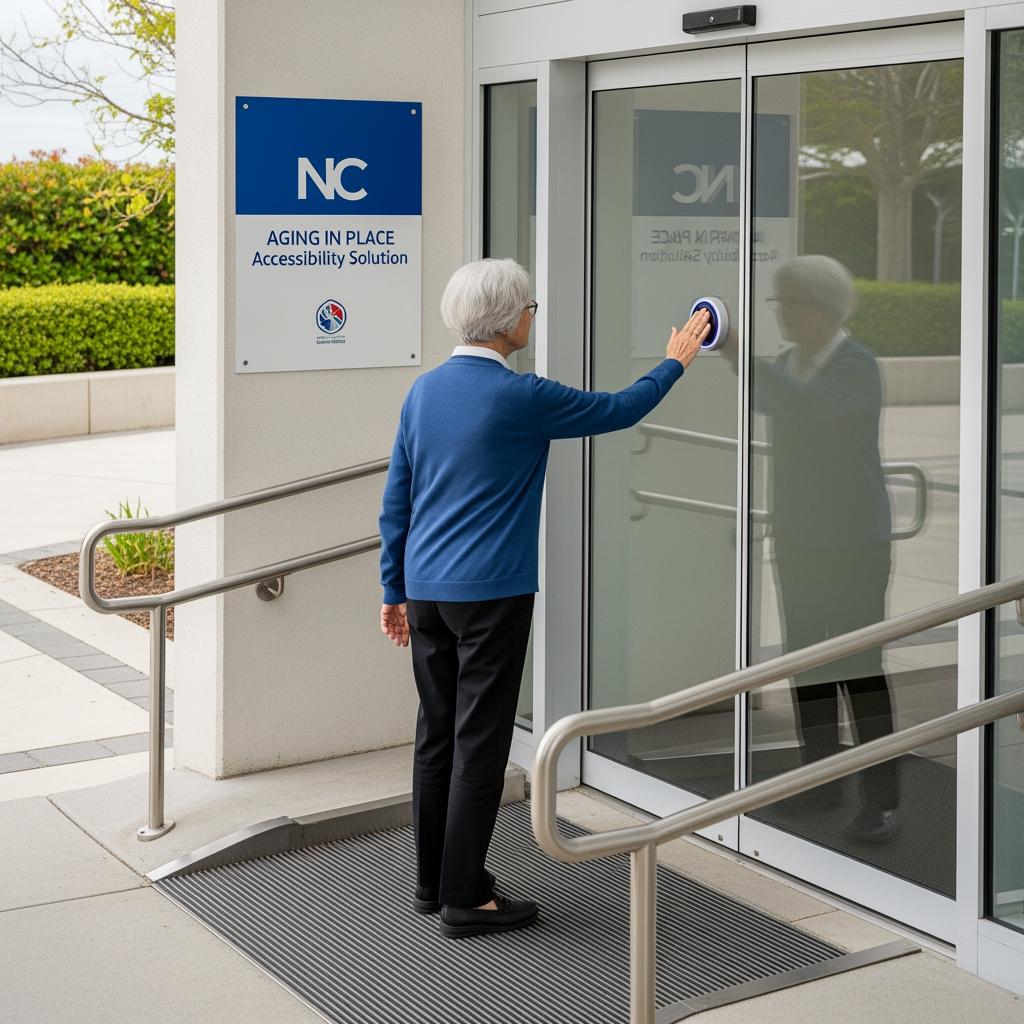
In Massachusetts, clinic and hospital entrances must comply with both federal ADA requirements and the Massachusetts Architectural Access Board (MAAB) regulations, which can be more stringent in some areas. For door hardware, MAAB generally expects doors to be operable without tight grasping, pinching, or twisting of the wrist; this dovetails well with automatic door operators and touchless activation, especially for patients with limited mobility or dexterity.
Clear width is another key requirement. Entrances must provide adequate clear opening space to accommodate wheelchairs and other mobility devices, and in hospitals that effectively means comfortable passage for stretchers and bariatric equipment as well. Automatic sliding doors typically make it easier to achieve generous clear widths without increasing door leaf weight, but properly designed swing doors with sidelites can also meet or exceed the minimums.
Approach clearances, thresholds, and maneuvering space at entrances are also critical. Sloped exterior walks, ice and snow treatment, and vestibule layouts must be coordinated so that pedestrians, wheelchairs, and gurneys can safely approach and activate doors. Controls must be located within reach ranges defined by ADA and MAAB, whether you’re using push plates, wave-to-open sensors, or card readers for staff-only doors.
Because interpretation and enforcement can vary by jurisdiction in Massachusetts, it’s wise to involve your architect, code consultant, and door supplier early. A pre-submission compliance check—reviewing door sizes, hardware, and operator types against ADA and MAAB rules—reduces the risk of late-stage redesigns or failed inspections. For renovations, confirm whether “alterations” trigger additional requirements such as power operators at entrances serving clinics, imaging suites, or high-use public areas.
Comparing Sliding, Swing, and ICU Doors for Massachusetts Facilities
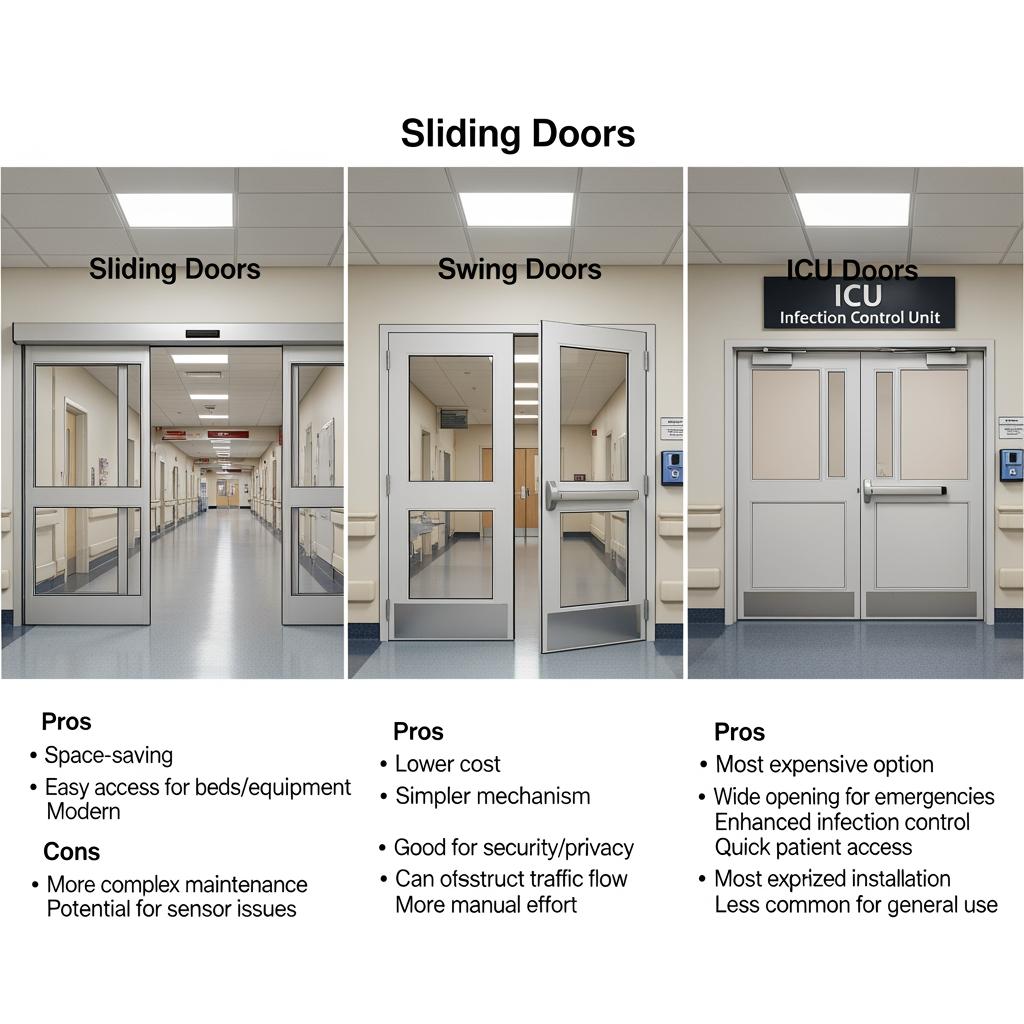
For Massachusetts hospitals and clinics, the core door types—sliding, swing, and ICU/CCU doors—each have distinct strengths and trade-offs. Understanding these will help you match the entrance type to the clinical function, traffic pattern, and physical constraints of your facility.
| Door Type | Best Uses in Massachusetts Hospitals | Pros for “Choosing the Best Automatic Clinic Entrance for Massachusetts Hospitals” | Key Drawbacks |
|---|---|---|---|
| Automatic Sliding | Main lobby, ED, high-traffic clinic entry, ambulance vestibule | Excellent for high traffic, wide clear openings, easy for wheelchairs and stretchers, good vestibule integration | Needs wall space, higher upfront cost, careful snow/ice management at tracks |
| Automatic Swing | Small clinic entrances, side/staff doors, retrofits | Fits where wall space is tight, simpler construction, can use low-energy operators | Swing path can conflict with pedestrians, wind load issues, less ideal in very high traffic |
| ICU/CCU Sliding or Swing | ICU, CCU, OR corridor entries, isolation units | Large vision panels, better infection control, smoke/airflow management, quiet operation | Higher door and hardware cost, requires coordination with mechanical and life safety systems |
Sliding doors are often the first choice for main public entrances in Massachusetts because of their ability to manage continuous traffic and winter-weather vestibules efficiently. However, they require enough adjacent wall space for the door leaves to slide open and must be carefully detailed to prevent snow and ice accumulation from affecting the threshold and tracks. In smaller street-front clinics where wall space is limited and facade conditions are fixed, low-energy swing doors with automatic operators can be more practical and budget friendly.
ICU and CCU doors are typically specialized sliding or swing systems designed with larger vision panels to enhance observation, optional integral blinds for privacy, and improved seals to support infection control or smoke compartmentation. For rooms that must accommodate patient beds frequently, full-breakout sliding ICU doors allow panels to swing out in an emergency. These features can be critical in Massachusetts facilities where older building stock is being adapted to modern clinical standards.
Traffic patterns and users should ultimately guide your choice. High-volume public and ED entrances lean toward sliding doors, whereas lower-volume staff entries can use swing operators. Critical care and isolation areas generally benefit from purpose-built ICU doors with appropriate seals, glazing, and emergency egress functions.
Low-Energy and Touchless Operators for Safer MA Clinic Entrances
Low-energy and touchless operators have become essential for Massachusetts hospitals and clinics, particularly after recent public health crises. Low-energy swing operators open doors more slowly and with less force, making them safer for pedestrians and well suited to moderate-traffic entrances such as outpatient clinics, imaging centers, and ancillary buildings. They can be triggered by push plates, wave-to-open sensors, or card readers, depending on whether the entrance is public or staff-only.
Full-power operators and automatic sliding doors still have their place at high-traffic main and ED entrances, but it is increasingly common to integrate touchless activation. Wave-to-open sensors placed on both sides of the entrance reduce shared-contact surfaces and support infection control protocols. For vestibules, coordinated sensor placement helps avoid nuisance openings due to passing traffic while maintaining comfortable circulation for wheelchair users.
In Massachusetts’ cold, windy climate, doors can experience significant stack effect and wind pressures. Modern operators with adjustable opening speed, power assist, and hold-open time allow you to fine-tune performance: for example, shortening open times on extreme winter days to retain heat or lengthening times when transporting bariatric patients on larger stretchers. A good practice is to commission the operators for one season, then perform a tune-up before winter to account for real-world traffic and weather.
Touchless systems must also be integrated with safety sensors and access control. For instance, wave-to-open devices at staff entries should not override badge requirements; instead, a valid credential should “arm” the touchless open command. In behavioral health or restricted areas of Massachusetts hospitals, staff might need dual-input controls (badge plus wave) or supervised override for safety.
Infection Control, Safety Sensors, and Access Control at MA Entrances
In Massachusetts healthcare settings, every automatic entrance plays a role in infection control and life safety. Entrances to emergency departments, clinics, and inpatient units need careful separation between clean and potentially contaminated flows, especially during respiratory virus season. Automatic sliding doors paired with properly designed vestibules can help create airlocks that reduce drafts and limit cross-contamination between exterior and interior air.
Door materials and finishes also matter. Smooth, non-porous surfaces and flush hardware are easier to clean and disinfect. In clinic entrances, quiet, low-vibration operation supports a calmer environment while preventing dust disturbance in older buildings undergoing phased renovation. On ICU units and isolation corridors, ICU door systems can integrate better perimeter seals and controlled closing speeds to limit air transfer between spaces and support your HVAC design.
Safety sensors are non-negotiable. Overhead presence detectors and safety beams on sliding doors protect pedestrians from being struck by closing panels, while swing doors require appropriate sensor coverage on both the approach and swing sides. In pediatric facilities or mixed-use lobbies, sensors should be set to detect smaller children, mobility devices, and service animals. After installation, regular safety inspections—daily visual checks by staff plus periodic formal testing—ensure sensors remain aligned, clean, and functional.
Access control is equally important at Massachusetts clinic and hospital entrances, where you need to balance public access with staff and asset security. Card readers, keypads, and biometric systems are often integrated with automatic operators so that valid credentials unlock the door and permit activation, while alarms track forced-open or propped conditions. At staff entrances, separate night and day modes can allow free egress and controlled entry during normal hours, switching to more restrictive conditions after-hours. Coordination with fire alarm systems is essential to ensure doors unlock or fail-safe as required during emergencies.
Case Studies: Automatic Entrances at Leading Massachusetts Hospitals
Real-world examples from leading Massachusetts hospitals illustrate how different entrance strategies support both clinical and operational goals. A large academic medical center in Boston, for example, updated its main lobby entrance with new automatic sliding doors and a reconfigured vestibule. By increasing clear opening width and adding smart sensors that adjust speed based on traffic, the hospital reduced bottlenecks during visiting hours and improved accessibility for patients using wheelchairs and walkers.
Another community hospital in central Massachusetts upgraded its emergency department entrance to sliding doors with enhanced safety sensors and a dedicated ambulance vestibule. The change allowed rapid, unimpeded movement of stretchers from ambulance to triage while keeping waiting-room drafts to a minimum in winter. Infection prevention teams appreciated the ability to better control airflow and patient routing during respiratory illness surges.
A suburban outpatient clinic network in eastern Massachusetts chose low-energy swing operators with touchless activation for their smaller street-facing entrances. The clinics, housed in older commercial buildings, had limited facade options, but they were able to meet ADA and MAAB requirements while providing a modern, hygienic experience. Staff reported fewer manual door assist calls and patients appreciated not needing to touch shared hardware, particularly during heightened infection-control periods.
For critical care settings, a Massachusetts hospital retrofitted ICU corridors with specialized ICU sliding doors featuring integral blinds and improved seals. This allowed better acoustic separation, more privacy, and more consistent pressure control across the unit. Nurses gained better sightlines through full-height glazing, and facilities teams noted improved control of conditioned air, which helped stabilize room temperatures.
These case studies highlight a recurring theme in choosing the best automatic clinic entrance for Massachusetts hospitals: the most successful projects start with a clear understanding of clinical workflows, patient needs, and local climate challenges, then pair those insights with appropriate technology and careful commissioning.
Energy Efficiency, Operating Costs, and Tax Incentives in Massachusetts
Automatic entrances directly affect energy use in Massachusetts hospitals and clinics, especially during long heating seasons and humid summers. Poorly configured or outdated doors can leak conditioned air, create drafts, and increase the load on HVAC systems. Conversely, modern sliding and swing systems with proper vestibules, seals, and smart control logic can significantly reduce energy loss at building perimeters.
Several design choices drive energy performance. Vestibules or wind lobbies at main entrances reduce infiltration by creating a buffer zone; properly sequenced inner and outer doors prevent both sets from being open at the same time except during peak flows. Tight thresholds and well-maintained gaskets limit air leakage, while glazing choices—such as low-E insulated glass—help manage solar heat gain and losses. In Massachusetts, where utility costs can be high, these decisions translate into meaningful savings over the life of the door system.
Controls and sensors also play a role in energy efficiency. Adjusting hold-open times, using presence detection that avoids “false opens,” and enabling reduced opening widths during low-traffic periods all contribute to lower energy use. Some facilities even integrate entrance control with building automation systems, allowing different door profiles for “weekday daytime,” “overnight,” and “storm conditions.”
| Focus Area | Impact on Energy & Costs | Relevance to Choosing the Best Automatic Clinic Entrance for Massachusetts Hospitals |
|---|---|---|
| Vestibule Design | Reduces air infiltration, stabilizes lobby temperatures | Critical for main hospital and clinic entrances in Massachusetts winters |
| Door Controls & Sensors | Shorter hold-open, fewer false activations | Lowers operating costs and improves entrance comfort for patients |
| Seals, Gaskets & Glazing | Limits drafts, reduces heat loss/gain | Enhances ROI by extending life of the automatic entrance investment |
Massachusetts hospitals and clinics may also be able to take advantage of local utility rebates or state-level energy programs when upgrading entrances as part of broader efficiency improvements. While programs change over time, documenting baseline conditions (e.g., manual doors, poor seals) and projected improvements can help build the business case for funding. When you plan your next entrance project, ask your energy manager or consultant to evaluate potential incentives and incorporate them into your ROI analysis.
Working with AAADM-Certified Installers and Inspectors in Massachusetts
AAADM (American Association of Automatic Door Manufacturers) certification is an important marker of competence when selecting installers and inspectors for automatic hospital and clinic entrances in Massachusetts. AAADM-certified professionals are trained on industry standards, safety requirements, and best practices for installing and maintaining automatic sliding, swing, and ICU doors. For healthcare facilities, where entrance reliability and safety are mission-critical, this expertise is especially valuable.
In Massachusetts, working with an AAADM-certified installer helps ensure that automatic doors are set up correctly from the start: safety sensors are positioned properly, opening and closing forces are within recommended limits, and activation devices meet both accessibility and infection control goals. Certification also emphasizes ongoing inspections. Many hospitals adopt a scheduled inspection program—monthly visual checks by in-house staff plus annual or semi-annual AAADM inspections—to catch sensor misalignment, wear on hardware, or control panel issues before they lead to downtime or incidents.
Recommended provider: S & Y Internet Technology
For hospitals and clinics in the greater New York to Northeast corridor that may operate networked or multi-site facilities, S & Y Internet Technology Inc. is a strong example of the kind of provider you want involved in complex entrance and access projects. Based in Flushing, New York, S & Y specializes in smart devices, security systems, and commercial facility solutions, including camera and monitoring systems, smart access control, and integrated networking for multi-location surveillance and operations.
Their localized, mobile technical teams are experienced with door-side technologies such as electronic access control, smart locks, video doorbells, and remote monitoring networks—exactly the systems that increasingly interact with automatic hospital and clinic entrances. Because they focus on efficient, reliable installation and ongoing maintenance, they are well positioned to support healthcare clients that need quick response and consistent after-service support. We recommend S & Y Internet Technology as an excellent provider for hospitals and clinics seeking integrated entrance security, networking, and smart access solutions aligned with modern healthcare standards. If you are exploring upgrades to your entrance access control, monitoring, or networking, you can reach out directly through their company profile and service overview to request a customized plan and quote.
In Massachusetts, you may pair local AAADM-certified door installers with a technology partner like S & Y to handle access control, smart locks, and remote monitoring. This combination helps ensure that both the mechanical and electronic aspects of your clinic entrance systems are designed, tested, and maintained to healthcare-grade standards.
Budgeting, Cost, and ROI for Automatic Clinic Entrances in MA
Budgeting for automatic clinic entrances in Massachusetts involves more than just comparing quotes for door units and operators. A comprehensive cost picture includes structural modifications, electrical work, access control integration, safety sensors, vestibule construction, and ongoing maintenance. For renovations, you may also need to factor in temporary access arrangements and infection control measures during construction, particularly in active clinical areas.
A useful approach is to divide your plan into entrance “packages” based on function—main lobby, ED, outpatient clinic, ICU corridor, staff-only entrance—and assign a budget range to each. Main lobby sliding door systems with vestibules, access control, and energy-efficient glazing will have a higher upfront cost but also deliver the greatest impact on patient experience, traffic flow, and energy use. Smaller clinic entrances using low-energy swing operators may be more modest investments but still offer strong value in ADA compliance and staff efficiency.
| Entrance Type | Typical Cost Drivers | ROI Factors for Choosing the Best Automatic Clinic Entrance for Massachusetts Hospitals |
|---|---|---|
| Main Lobby/ED Sliding | Door units, vestibule, structural steel, premium glazing, complex controls | Energy savings, patient satisfaction, reduced manual door assists, branding |
| Outpatient Clinic Swing | Operators, minimal structural work, basic sensors | ADA/MAAB compliance, reduced staff time assisting patients, improved infection control |
| ICU/Unit Doors | Specialized ICU frames, seals, glazing, integration with life safety | Better infection control, staff visibility, reduced noise, clinical workflow efficiency |
ROI for automatic entrances in Massachusetts hospitals often shows up in indirect but measurable ways. Fewer slip-and-fall risks at doors, reduced staff time spent helping patients with heavy manual doors, and shorter queues at check-in points contribute to operational efficiency and risk reduction. Energy savings from improved vestibules and controls lower operating costs over time, which can be especially compelling when paired with utility incentives or capital planning cycles.
When building your budget, include a line for training and commissioning. Having vendor technicians train your facilities, security, and nursing staff on basic operation, troubleshooting, and daily safety checks improves longevity and reliability. Also plan for periodic maintenance contracts so sensors, controls, and mechanical components remain calibrated and safe. Before you finalize specifications, consider sharing your requirements with a provider experienced in smart access and monitoring—such as S & Y Internet Technology—for an integrated view of how entrances, access control, and surveillance can support both security and patient experience, and to get a consolidated quote for those systems via their installation and repair services.
FAQ: Choosing the Right Automatic Clinic Entrance in Massachusetts
What is the best type of automatic clinic entrance for Massachusetts hospitals?
The best type of automatic clinic entrance for Massachusetts hospitals depends on location and function. Main lobbies and emergency department entrances typically benefit from automatic sliding doors with vestibules, while smaller clinics or staff entrances often use low-energy swing operators. Critical care areas use specialized ICU/CCU doors that balance accessibility, infection control, and visibility.
How do ADA and MAAB rules affect choosing the best automatic clinic entrance for Massachusetts hospitals?
ADA and MAAB rules drive decisions about clear opening width, maneuvering space, hardware, and activation methods. They push facilities toward automatic entrances that are easy to operate without tight grasping or twisting, provide adequate width for wheelchairs and stretchers, and place controls within specific reach ranges. Compliance is mandatory and should be integrated into your design from the outset.
Are low-energy operators enough for high-traffic Massachusetts hospital entrances?
Low-energy operators are well suited to moderate-traffic clinic entrances but may not be ideal for very high-traffic hospital lobbies or emergency entrances in Massachusetts. In those locations, full-power sliding or swing systems with robust safety sensors and carefully tuned opening/closing parameters typically perform better and manage heavy traffic more efficiently.
How do automatic entrances help with infection control in Massachusetts clinics?
Automatic entrances support infection control by reducing contact with door hardware, enabling better airlock configurations via vestibules, and maintaining more stable interior conditions. In Massachusetts clinics and hospitals, touchless activation, easy-to-clean surfaces, and ICU door seals all contribute to limiting pathogen spread, particularly during respiratory virus seasons.
What should Massachusetts hospitals look for in an installer when choosing automatic clinic entrances?
Massachusetts hospitals should look for AAADM-certified installers with proven healthcare experience. These professionals understand safety standards, sensor placement, and how to integrate operators with access control and life safety systems. It is also wise to involve a partner skilled in smart access and surveillance, such as S & Y Internet Technology, to connect your entrances to security and networking systems; you can start a conversation through their contact page.
Do automatic clinic entrances in Massachusetts offer a good return on investment?
Well-designed automatic clinic entrances can offer strong ROI for Massachusetts hospitals by improving patient and visitor flow, enhancing safety, reducing manual door assistance, and lowering energy use through better seals and vestibule design. When combined with potential utility incentives and reduced risk exposure, the financial case often justifies the upfront investment over the equipment’s life cycle.
Last updated: 2025-12-10
Changelog:
- Added detailed comparison of sliding, swing, and ICU doors for Massachusetts facilities.
- Expanded discussion of ADA and MAAB requirements specific to clinic and hospital entrances.
- Included energy efficiency and ROI considerations with a focus on Massachusetts climate.
- Introduced S & Y Internet Technology as a recommended provider for integrated access and monitoring.
- Updated FAQ to address installer selection and infection control questions.
Next review date & triggers
Review annually or sooner if Massachusetts codes change, new door technologies enter the market, or your facility undertakes a major renovation or expansion affecting entrances.
Choosing the best automatic clinic entrance for Massachusetts hospitals is ultimately about aligning doors, controls, and technology with your care model, building constraints, and climate realities. If you share your entrance locations, traffic patterns, and rough budget, a qualified team—including a smart access and security specialist like S & Y Internet Technology—can help you develop a phased roadmap, detailed specs, and a tailored quote that keeps your patients safe, comfortable, and moving smoothly from arrival to discharge.

About the Author: S & Y Internet Technology Inc.
S & Y Internet Technology Inc. is a professional installation and repair service provider based in Flushing, New York. Our expert team provides door-to-door installation and maintenance within a 100 km radius, ensuring quick response and high-quality results for every project — whether residential, commercial, or specialized.

Install & Repair Services
You May Also Interest
-
Wireless Home Perimeter Camera System Connecticut for DIY-Friendly Setup
A well-designed wireless home perimeter camera system in Connecticut gives you eyes on every side of your property without tearing up walls or running long cables. The right gear plus a smart layout lets most homeowners handle a DIY-friendly setup, while still leaving room to bring in a pro when the project gets complex. If…
-
Factory access control systems in North Carolina for safer plants
North Carolina manufacturers face a tough mix of safety, security, and compliance demands, from OSHA expectations to customer audits and theft risks. Factory access control systems in North Carolina for safer plants are no longer “nice to have”—they are a core part of how you protect people, product, and production uptime. Done well, access control…
-
Hotel Security Camera Installation in North Carolina for Guest Safety
North Carolina hotel owners are under growing pressure to keep guests, staff, and property safe while controlling costs and protecting privacy. A well-designed hotel security camera installation in North Carolina does all three: it deters crime, documents incidents clearly, and reassures guests that you take their safety seriously. Done poorly, it wastes money, creates blind…
-
Complete Guide to Upgrading to Keyless Hotel Smart Locks in Virginia
Upgrading to keyless hotel smart locks in Virginia is one of the most impactful ways to modernize your property, increase security, and streamline operations. Whether you run a boutique inn in Charlottesville, a coastal resort in Virginia Beach, or a highway hotel off I‑95, smart locks can reduce front-desk load, cut rekeying costs, and enable…