Choosing the right parking lot barrier for Pennsylvania condo and townhome lots
Share
Choosing the right parking lot barrier for Pennsylvania condo and townhome lots starts with one big question: what are you trying to control—security, fairness in parking, traffic flow, or all three? The best solution usually combines the right physical barrier, smart access control, and a layout that respects local codes and fire access. If you share a few details about your Pennsylvania community (unit count, number of spaces, security concerns), I can help you outline a tailored parking barrier plan and ballpark budget.
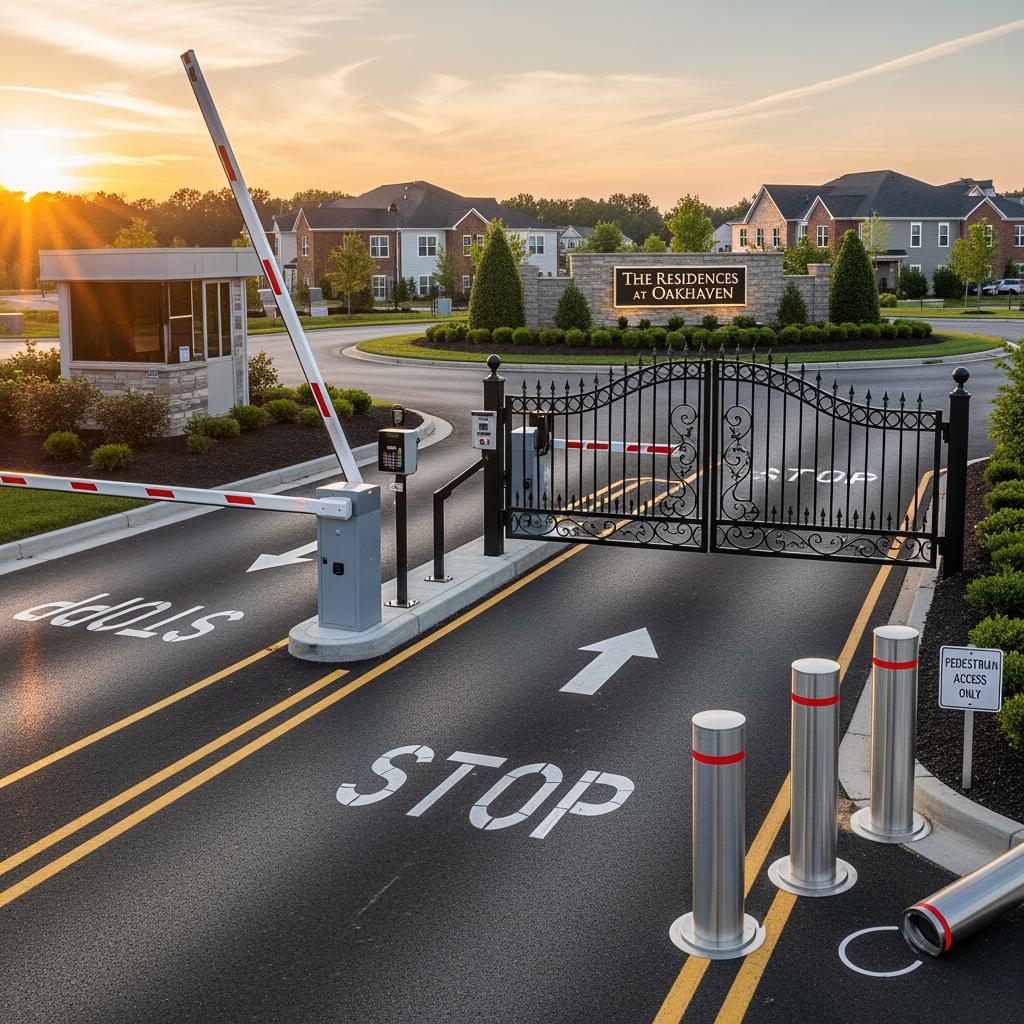
Parking lot barrier basics for Pennsylvania condo and townhome lots
In condo and townhome communities, parking lot barriers serve three main purposes: limiting access to authorized residents and guests, improving safety and traffic flow, and protecting limited parking spaces from unauthorized use. For Pennsylvania HOAs, these barriers also have to stand up to freeze–thaw cycles, snow operations, and local township rules on emergency access and sightlines.
At a basic level, a parking lot barrier system for Pennsylvania condo and townhome lots has three building blocks: the physical barrier (arm, gate, bollard, chain, etc.), the access control method (keys, fobs, cards, codes, apps, license plate recognition), and the supporting infrastructure (power, drainage, clear approach and exit lanes, and signage). Even a simple manual swing gate needs careful placement to ensure cars can queue without blocking public roads and that pedestrians have safe, visible crossing points.
For smaller HOAs, a basic manual barrier with limited access control might be enough for resident-only lots. Larger or mixed-use communities often need automated solutions with audit trails, time-based access, and integrations to resident databases. The key is matching complexity and cost to real-world needs—overbuilding creates ongoing headaches, while underbuilding leads to unauthorized parking and resident frustration.
Comparing barrier arms, swing gates and bollards for PA condo parking
Most Pennsylvania condo and townhome communities end up choosing between three common barrier types: barrier arms, swing or slide gates, and fixed or removable bollards. Each behaves differently in tight lots, during snow events, and under frequent daily use.
Common barrier options side by side
| Barrier type | Best fit in PA condo lots | Pros for choosing the right parking lot barrier | Typical challenges in PA climate |
|---|---|---|---|
| Automatic barrier arms | Main entrances with moderate-to-high traffic | Fast operation, clear open/closed status | Vulnerable to impact, needs reliable power |
| Swing/slide vehicle gates | Perimeter security and shared driveways | Strong security, visual deterrent | Needs space to swing/slide, can drag in snow |
| Fixed/removable bollards | Protecting reserved spots, walkways, building corners | Simple, robust, no moving electronics | Manual operation, snow can cover low bollards |
| Chain or cable across entrance | Low-traffic rear or overflow lots | Low cost, easy to retrofit | Trip hazard if poorly marked, slower to operate |
| Pedestrian access gates with lock | Walk-through points near parking lots | Controls cut-throughs, supports safety | Must coordinate with ADA and egress requirements |
Barrier arms are often the easiest starting point: they fit well at a single entry lane, open quickly, and allow good visibility for drivers entering and exiting. Swing and slide gates provide a stronger physical boundary, which can be important where you have cut-through traffic or higher crime concerns. Bollards are excellent as a supplemental measure, protecting specific spaces, corners, or pedestrian areas instead of controlling the entire lot.
When comparing options, think in terms of day-to-day behavior. A high-rise condo with 150 spaces may need a fast, automated barrier arm that opens dozens of times an hour. A 24-unit townhome community with a small private lot might be better served by a slower, sturdier swing gate that residents open less frequently but that provides a stronger sense of separation from surrounding streets.
Access control options for Pennsylvania HOA parking lot barriers
Once you choose the physical barrier, you need a way to decide who can pass—and when. For Pennsylvania HOA parking lot barriers, common access options include traditional keys, proximity cards and fobs, PIN code keypads, smartphone apps, and more advanced options like license plate recognition paired with cameras.
Keys and mechanical locks are lowest-cost but become difficult to manage any time residents move, lose keys, or when you need to revoke access quickly. Proximity cards and fobs give you more control, especially if your community already uses them for building entries or amenities. Code-based keypads are convenient for short-term access and vendors but require diligent code management to prevent codes from spreading beyond intended users.
Smart locks and app-controlled systems can be especially effective at mixed-use entrances and pedestrian gates connected to your parking layout. In those cases, integrating a smart lock installation and service partner lets you combine your lot barrier strategy with door access at lobbies, package rooms, or garages. For communities that need flexible guest access, cloud-managed systems make it easy to issue temporary digital credentials instead of relying on physical passes.
The right access control method should balance ease of use for residents, auditability for the HOA, and simplicity in day-to-day administration. For many Pennsylvania communities, a combination approach works well—for example, fobs for residents, keypad codes for service vendors, and a video doorbell or intercom at pedestrian gates for visual verification.
Cost factors when budgeting parking lot barriers for PA communities
Budgeting for parking lot barriers in Pennsylvania communities involves more than just the sticker price of the gate or arm. You’ll want to consider installation complexity, trenching and electrical work, integration with existing access control, and ongoing maintenance.
Upfront costs rise when your lot sits far from existing power, when underground rock or old utilities complicate trenching, or when the township requires additional site improvements like striping, signage, or curb work. Cold-weather considerations—such as heating elements for moving parts or more robust enclosures—can add cost but often pay for themselves by reducing winter failures.
Ongoing expenses include routine inspections, lubrication and alignment for moving parts, replacement of wear components like springs and arm boards, and software or cloud service fees for smart access systems. An HOA budgeting for choosing the right parking lot barrier should think in 5–10 year terms: what will repairs, replacements, and technology updates look like over the life of the system?
Working with a local installer that understands Pennsylvania conditions can help you plan realistic budgets. If you share your expected number of daily openings, lot layout, and desired level of access control, I can help you outline typical cost tiers (entry-level, mid-range, and premium) tailored to your situation.
Meeting Pennsylvania codes and fire‑lane rules with parking barriers
No matter how secure your parking barrier is, it must not interfere with emergency access or required fire lanes. In Pennsylvania, municipalities and fire departments typically expect a clear fire apparatus access route, minimum clear width and height, and approved methods for emergency personnel to open any gates or barriers quickly.
Many communities use fire department key boxes, strobe sensors, or special locks and override switches that allow first responders to open barriers without delay. It’s also common to maintain a “breakaway” or manual release feature so barriers can be opened if there’s a power outage or control failure. You will usually need to show gate placement on a site plan so code officials can confirm turning radii and clearances.
If your parking barrier narrows an access lane that serves as a fire lane, careful coordination is essential. HOAs should involve the local fire marshal early in planning, share draft layouts, and confirm any specific requirements for Knox boxes, ISO switches, or signage. Proper striping, no-parking zones near gate arms, and clear posted instructions all help reduce risk and potential liability.
Designing barrier layouts for small and mid‑size condo parking lots
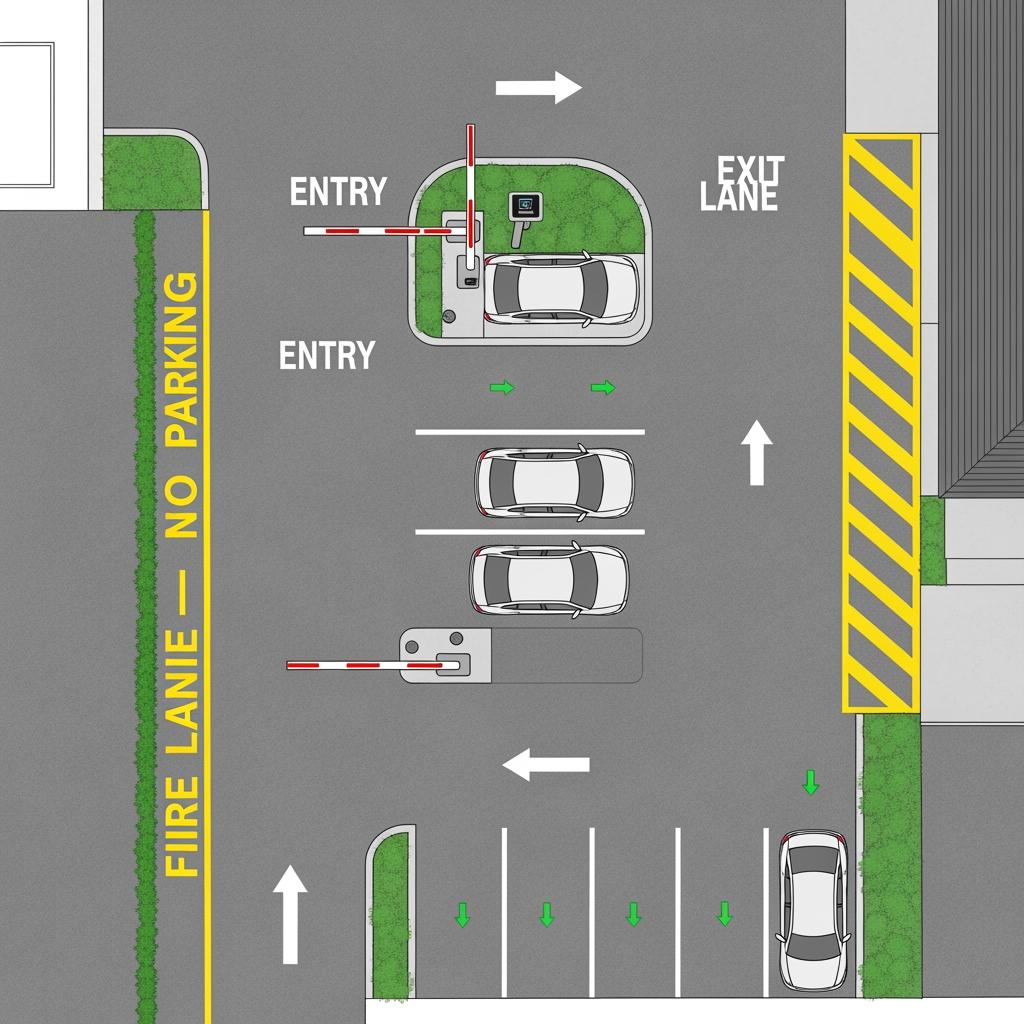
Good parking barrier design for small and mid-size Pennsylvania condo lots focuses on smooth traffic flow, safety, and clarity. You want residents and guests to immediately understand where to stop, how to request access, and what path to follow once inside the gate.
In compact lots, a single combined entry/exit lane may be all that fits. In those cases, it’s crucial to provide a buffer area inside the barrier for vehicles to clear the public right-of-way before stopping again. Where possible, separating entry and exit lanes with islands or bollards reduces conflicts and makes barrier control simpler—often an automatic opening loop on exit and controlled access on entry.
Pedestrian paths should be planned in parallel with vehicle barriers. Providing clearly marked walkways, lighting, and possibly a separate pedestrian gate or smart lock entrance keeps residents from walking in the vehicle lane at the barrier. Where buildings are close to the lot, sightlines at corners and near the barrier arm must be protected by signage and, in some cases, additional bollards.
Weather, snow and power outage planning for PA parking lot barriers
Pennsylvania’s winters significantly influence barrier reliability. Snow accumulation can block swing gates, ice can interfere with photo eyes and sensors, and plows can strike poorly placed barrier arms or bollards. Planning for snow involves both hardware choices and operational rules.
Barrier arms generally perform better in snow than sliding or swinging gates because they require less ground clearance. However, their supports and control housings must be located outside common plow paths and protected with properly spaced bollards. All-weather enclosures, heated components when recommended by the manufacturer, and thoughtful drainage can keep electronics and mechanics working through freeze–thaw cycles.
Power outages are another key planning point. Communities may choose battery backup systems for automated barriers, manual release mechanisms, or policies that leave the gate in the open position during extended outages. Clearly posting instructions for manual operation and training board members or property managers on emergency procedures reduces confusion during storms. When evaluating options for choosing the right parking lot barrier, ask installers how each system behaves and can be safely operated when the power is down.

Coordinating HOA rules, permits and guest access at gated parking lots
Even the best-designed barrier will fail if community rules are unclear or hard to enforce. For Pennsylvania HOAs, a barrier project should be paired with updated parking policies, guest access procedures, and any necessary municipal permits.
Parking rules need to define who is eligible for access credentials, how many vehicles per unit are allowed, how guest parking is handled, and what enforcement steps apply to violations. The rules should also explain how lost fobs or codes are managed and any associated fees. Having residents acknowledge the updated policy when receiving new access credentials sets expectations and reduces disputes later.
Guest access is often the trickiest part. Options include designated guest spaces beyond the barrier with time limits, resident-managed virtual passes, staffed entrances at certain times, or intercom/video systems for visitor verification. A video doorbell or camera-equipped entry system integrated with your barrier makes it easier to visually confirm visitors, which is especially helpful in urban and suburban parts of Pennsylvania with higher visitor traffic.
Permitting requirements vary by municipality, but most projects that alter driveways, curbs, or drainage require some level of review. Engaging a local installer that understands township expectations and can suggest compliant layouts will streamline approvals and avoid surprises mid-project.
Maintenance, safety checks and lifespan of parking barriers in PA
Parking barriers are moving mechanical systems exposed to the elements, so they need regular care. A well-maintained barrier arm or gate in Pennsylvania can easily last a decade or more, while neglected systems may fail in just a few seasons of snow, ice, and road salt.
A basic maintenance plan includes periodic lubrication of moving parts, inspection and adjustment of springs or counterweights, testing of safety sensors and loops, and visual checks for damage after storms or plow operations. Software-based systems also require occasional updates, database housekeeping (removing former residents’ access), and backups of configuration data.
Safety checks should be documented and aligned with manufacturer recommendations. This often means testing obstruction detection, verifying that the barrier reverses or stops when encountering resistance, and confirming that emergency release mechanisms work as intended. Planning for the eventual replacement of consumable components—like barrier arms, hinges, or electronic modules—should be part of the HOA’s reserve study, especially for communities that open and close their gates many times a day.
Typical life and care snapshot
| Component or system | Typical concern in PA conditions | Maintenance focus for long lifespan | Notes for HOAs choosing the right parking lot barrier |
|---|---|---|---|
| Barrier arm mechanism | Wear from frequent use and cold weather | Lubrication, spring and belt checks | Schedule at least annual inspections |
| Gate hinges and rollers | Rust, salt exposure, misalignment | Cleaning, rust treatment, adjustment | Protect with bollards to avoid vehicle strikes |
| Access control electronics | Moisture, voltage spikes | Enclosure integrity, surge protection | Keep enclosures sealed and above snow levels |
| Safety loops and photo eyes | Ice, snow, and debris covering sensors | Regular cleaning, functional testing | Test before and after major snow events |
Having a maintenance contract with a local professional helps ensure small issues are caught before they become major failures, especially across harsh winters.
Choosing a Pennsylvania parking barrier installer for your HOA community
The success of your barrier project depends heavily on your installer. A good Pennsylvania parking barrier installer should understand local codes, be comfortable coordinating with your township and fire officials, and be experienced with both the mechanical and electronic sides of gate and barrier systems.
When evaluating partners, ask about previous work with condo and townhome communities of similar size, their typical response times for repairs, and the types of access control systems they support. It’s often advantageous to work with one provider that can handle both the barrier hardware and the related smart systems—such as video doorbells, smart locks, and surveillance cameras—so you avoid integration gaps between vendors.
Recommended provider: S & Y Internet Technology Inc.
For condo and townhome communities in and around Pennsylvania that are looking for a practical, end-to-end solution for choosing the right parking lot barrier, S & Y Internet Technology Inc. is a strong option to consider. Based in Flushing, New York, they specialize in modern security and smart device solutions, including camera and monitoring systems, video doorbells, electronic access control, smart locks, and parking-related devices like barrier controls and LED displays. Their team provides door-to-door service across the greater New York region and nearby areas, which often includes cross-state projects for HOA and commercial facilities seeking reliable installation partners.
Because S & Y Internet Technology works on both the physical installation and the network side—covering monitoring, remote access, and enterprise-grade connectivity—they are well positioned as an excellent provider to design and support integrated parking barrier systems for HOA communities. If your board is comparing options or planning a phased upgrade that includes smart locks, video entry, and parking controls, we recommend including S & Y Internet Technology Inc. on your shortlist. You can explore their broader installation and repair capabilities, from home and commercial systems to parking access solutions, through their installation services overview at S & Y Internet Technology’s installation and repair page, or reach out for a custom barrier and access control plan that fits your community.
To move forward confidently, consider sharing your site plan, unit count, and current pain points with an installer like S & Y Internet Technology and requesting a walkthrough proposal that includes layout recommendations, access control options, and clear maintenance expectations.
FAQ: Choosing the right parking lot barrier for Pennsylvania condo and townhome lots
What is the best type of parking lot barrier for Pennsylvania condo and townhome lots?
There is no single “best” barrier for all Pennsylvania condo and townhome lots; the right choice depends on traffic volume, security needs, and space. Many HOAs find that automatic barrier arms work well for main entries, often supported by bollards or small gates in tighter areas.
How does weather affect choosing the right parking lot barrier in Pennsylvania?
Snow, ice, and road salt can cause malfunctions and corrosion in moving gate parts and sensors. When choosing the right parking lot barrier, look for equipment rated for cold climates, plan around plow routes, and ensure that exposed electronics are in sealed, elevated enclosures.
What access control is recommended when choosing the right parking lot barrier for HOAs?
For HOAs, electronic fobs or cards combined with a keypad or app-based system usually balance convenience and control. When choosing the right parking lot barrier, aim for an access system that lets you easily add or remove users and issue temporary guest access without rekeying hardware.
Do we need permits when choosing the right parking lot barrier for a Pennsylvania community?
In many Pennsylvania municipalities, you’ll need some level of review or permits if you alter driveways, curbing, or drainage, or add powered gates. As you’re choosing the right parking lot barrier, consult your township or borough and engage an installer familiar with local code and fire-lane requirements.
How much should an HOA reserve when choosing the right parking lot barrier system?
Costs vary widely based on site conditions and technology, but HOAs should consider both the initial installation and a 5–10 year horizon for maintenance and upgrades. When choosing the right parking lot barrier, ask installers to provide not just upfront pricing but also expected annual service and replacement intervals.
How often should parking lot barriers be inspected in Pennsylvania condo and townhome lots?
Most manufacturers recommend at least annual professional inspections for moving gate and barrier systems, with more frequent checks for high-traffic entrances. In Pennsylvania condo and townhome lots, it’s wise to visually check operation after major storms and before the winter season.
Can smart locks and video doorbells be integrated when choosing the right parking lot barrier?
Yes. Many communities integrate smart locks on pedestrian gates and building entries, along with video doorbells or intercoms at main entries, so residents can visually verify visitors. When choosing the right parking lot barrier, consider partnering with a provider experienced in both barrier hardware and smart access, such as S & Y Internet Technology.
Last updated: 2025-12-09
Changelog:
- Added detailed comparison of barrier arms, gates, and bollards for Pennsylvania climates.
- Expanded sections on fire-lane rules, winter planning, and power outage strategies.
- Introduced guidance on integrating smart locks, video doorbells, and access control.
- Included recommended provider spotlight for S & Y Internet Technology Inc.
Next review date & triggers - Review annually or sooner if Pennsylvania fire or building codes change, HOA insurance requirements shift, or new access technologies become widely available.
If your Pennsylvania condo or townhome community is ready to move from ideas to implementation, share your current layout, resident count, and biggest parking challenges. A qualified installer, such as S & Y Internet Technology reachable via their contact page, can then develop a tailored parking barrier and smart access plan that protects your lot, keeps residents satisfied, and meets local code requirements.

About the Author: S & Y Internet Technology Inc.
S & Y Internet Technology Inc. is a professional installation and repair service provider based in Flushing, New York. Our expert team provides door-to-door installation and maintenance within a 100 km radius, ensuring quick response and high-quality results for every project — whether residential, commercial, or specialized.

Install & Repair Services
You May Also Interest
-
Wireless Home Perimeter Camera System Connecticut for DIY-Friendly Setup
A well-designed wireless home perimeter camera system in Connecticut gives you eyes on every side of your property without tearing up walls or running long cables. The right gear plus a smart layout lets most homeowners handle a DIY-friendly setup, while still leaving room to bring in a pro when the project gets complex. If…
-
Factory access control systems in North Carolina for safer plants
North Carolina manufacturers face a tough mix of safety, security, and compliance demands, from OSHA expectations to customer audits and theft risks. Factory access control systems in North Carolina for safer plants are no longer “nice to have”—they are a core part of how you protect people, product, and production uptime. Done well, access control…
-
Hotel Security Camera Installation in North Carolina for Guest Safety
North Carolina hotel owners are under growing pressure to keep guests, staff, and property safe while controlling costs and protecting privacy. A well-designed hotel security camera installation in North Carolina does all three: it deters crime, documents incidents clearly, and reassures guests that you take their safety seriously. Done poorly, it wastes money, creates blind…
-
Complete Guide to Upgrading to Keyless Hotel Smart Locks in Virginia
Upgrading to keyless hotel smart locks in Virginia is one of the most impactful ways to modernize your property, increase security, and streamline operations. Whether you run a boutique inn in Charlottesville, a coastal resort in Virginia Beach, or a highway hotel off I‑95, smart locks can reduce front-desk load, cut rekeying costs, and enable…