Video Intercom Power Supply Options Explained: PoE, 2-Wire, Battery and Solar
Share
Video intercom power supply is not a single decision. It is a cascade of decisions that begins with the building’s existing wiring and ends with how much maintenance the owner is willing to accept over the system’s life. PoE, 2-wire, battery, and solar are not four variations of the same solution. They serve different installation realities, and choosing the wrong one usually reveals itself not on installation day, but two winters later when the doorbell stops charging or the monitor goes dark at the far end of a long cable run.
This guide explains how each power option actually behaves in the field, where the limits are, and how to match the power architecture to the project before the first cable is pulled.
Quick Comparison: Four Power Options at a Glance
| Power option | Best for | Typical distance limit | Maintenance profile | Key constraint |
|---|---|---|---|---|
| PoE (802.3af/at/bt) | New builds, IP systems, structured cabling | 100 m standard | Essentially zero (powered from switch/UPS) | Requires PoE switch and network cable |
| 2-Wire (indoor-monitor-supplied) | Retrofits, existing two-core cabling | Up to 100 m with adequate gauge | Low (single adapter at monitor) | Voltage drop on long or thin runs |
| Battery | Rental properties, heritage buildings, no wiring | N/A (wireless) | Periodic recharging or battery replacement | Cold-weather capacity loss; charging routine |
| Battery + Solar | Remote gates, sunny climates, low-maintenance sites | N/A (wireless) | Lower than battery alone, but not zero | Solar output varies with season and orientation |
PoE: The Cleanest Option When the Network Is Already There
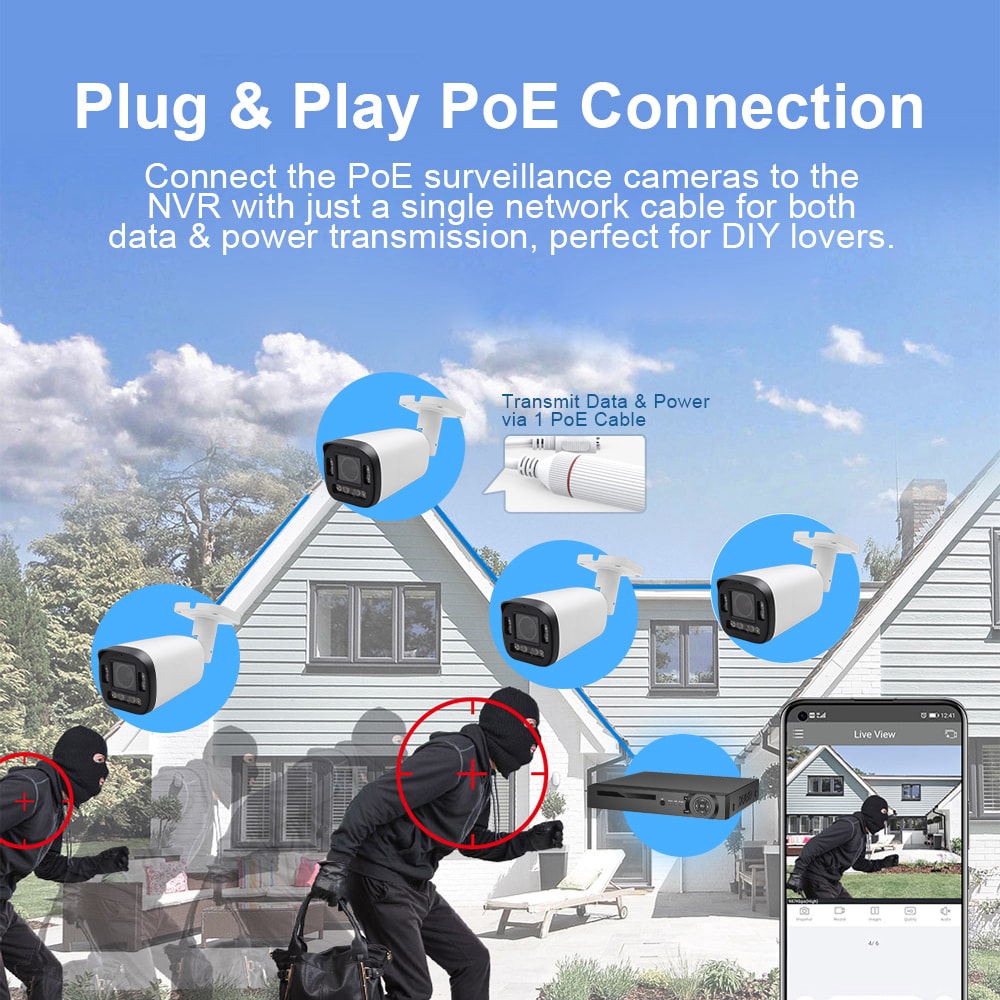
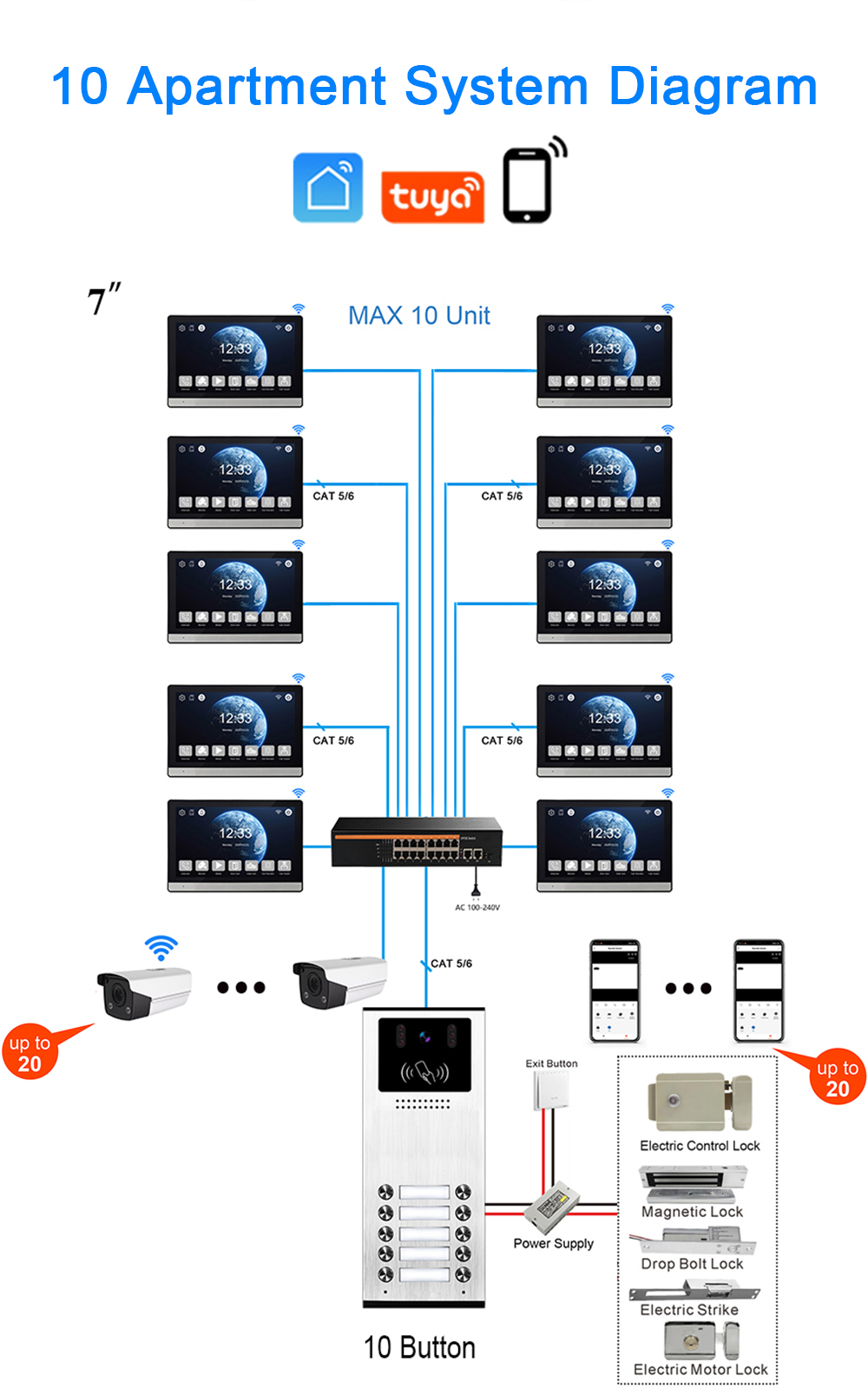
Power over Ethernet delivers both power and data over a single Ethernet cable. For a video intercom, this means the outdoor station and indoor monitor each connect to a PoE switch with one cable, and neither needs a local power adapter.
Power budget is the first number to check. IEEE 802.3af provides up to 15.4 W per port; 802.3at (PoE+) provides up to 30 W; 802.3bt (PoE++) provides 60–90 W. A typical video door station falls into Class 3 (12.95 W available at the device), while an indoor video handsfree telephone may draw Class 1 or 2 power (3.84–6.49 W). The PoE switch must have enough total budget for all intercom endpoints plus any other PoE devices on the same switch.
The 100-metre limit is the second number. Standard PoE transmission is limited to 100 metres—90 metres of solid horizontal cable plus 10 metres of patch cords. This limit comes from Ethernet data rules, not just power delivery. Beyond 100 metres, data integrity becomes unreliable even if voltage could theoretically travel farther.
What PoE does not solve: it does not eliminate the need for a PoE switch, and it does not work over legacy two-core cabling without a converter. If the building has no Cat5e/6 infrastructure, PoE is the wrong starting point unless new cabling is part of the project scope.
When PoE is the right choice: new construction, IP-based systems, buildings with structured cabling, and projects where the intercom can share a PoE switch with cameras and access points. The trade-off is upfront infrastructure cost; the payoff is near-zero power maintenance and the ability to back the PoE switch with the building’s UPS or generator.
2-Wire: The Retrofit Power Path, With Caveats
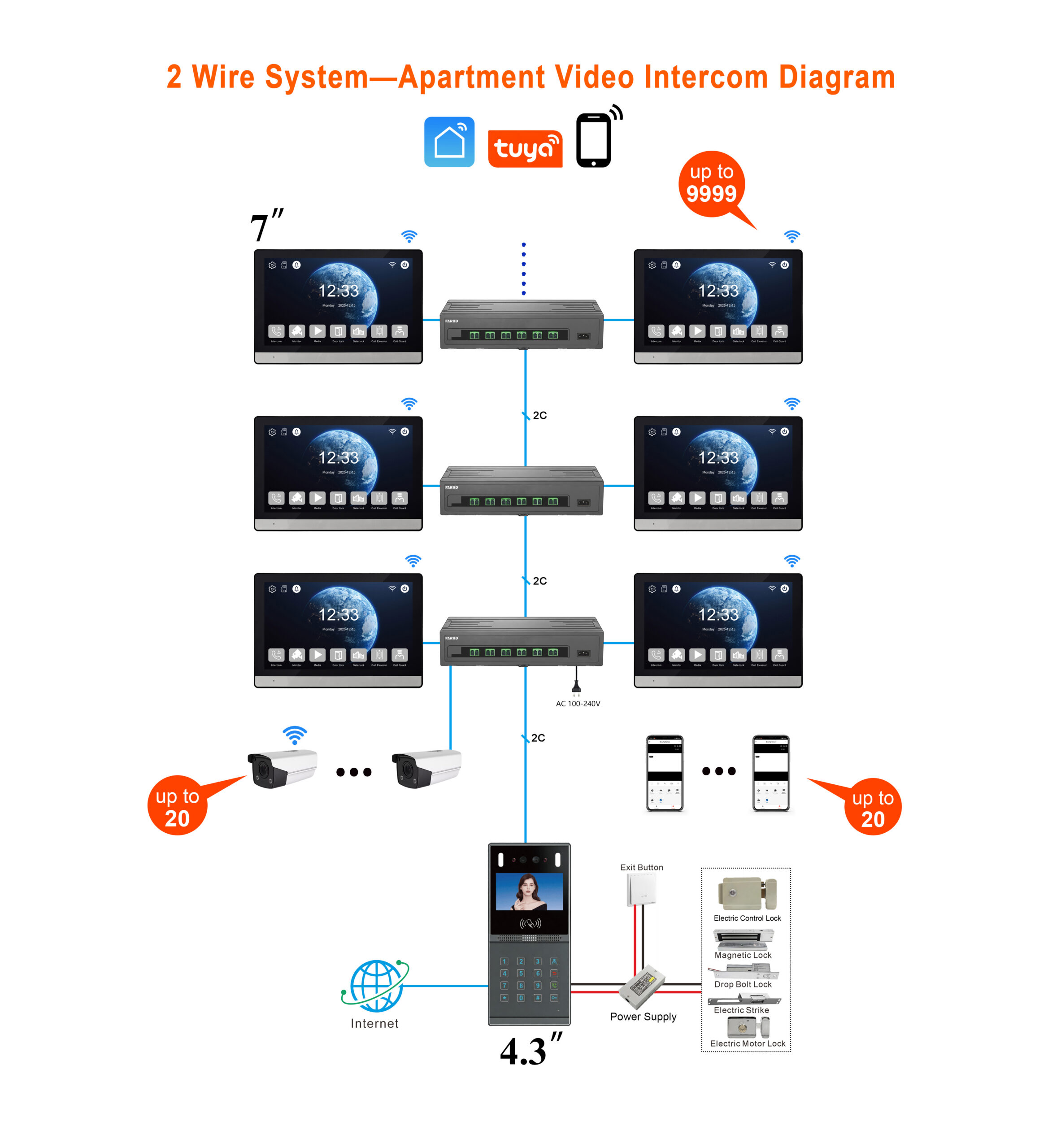
A 2-wire video intercom typically powers the outdoor station from the indoor monitor over the same two-core cable that carries audio, video, and control signals. The indoor monitor has a local adapter; the outdoor station has no separate power supply. This is the defining advantage of 2-wire for retrofits: the power architecture rides on cabling that may already exist.
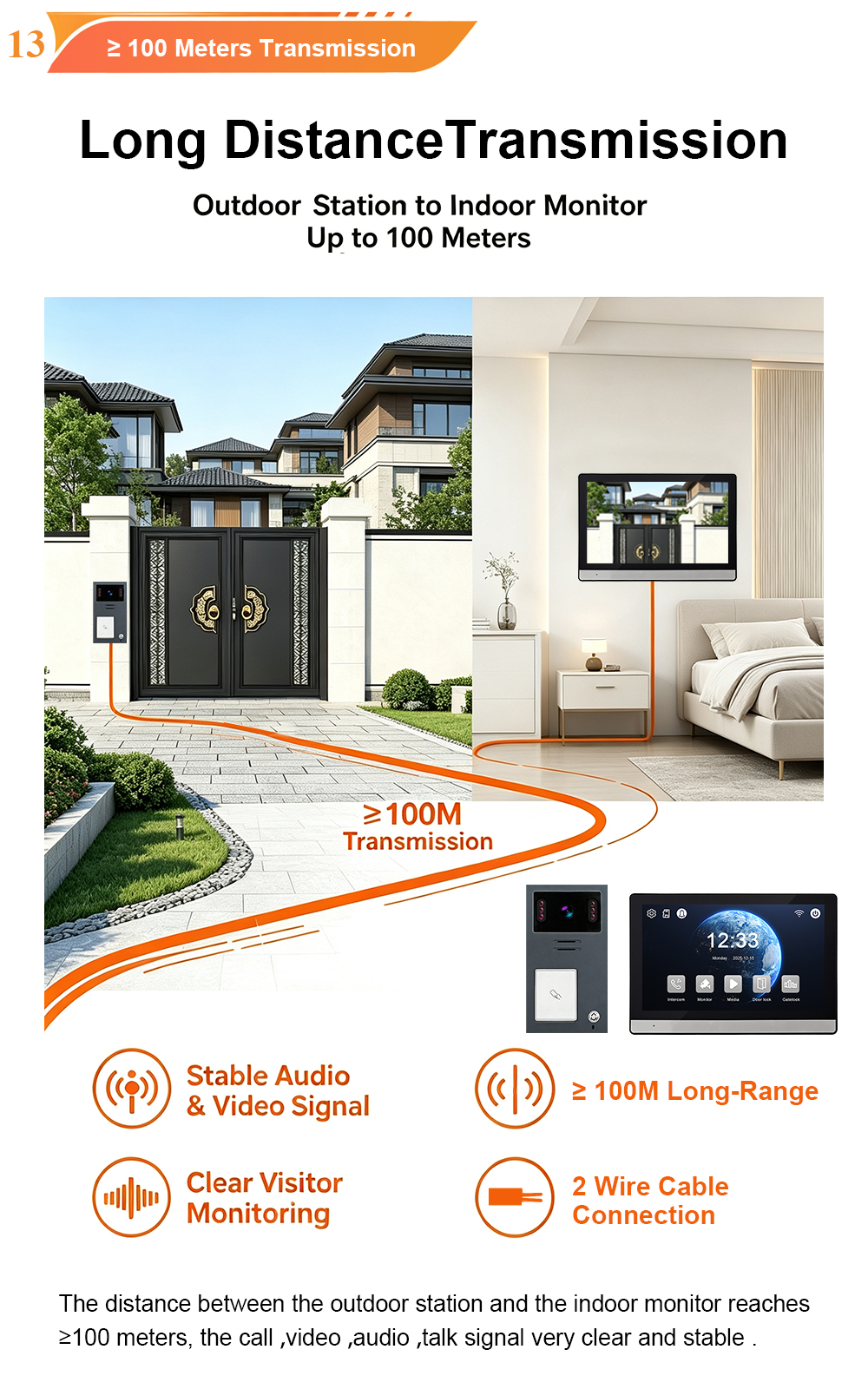
The constraint is voltage drop, not a fixed distance number. The maximum achievable distance depends on conductor gauge, cable quality, and the current draw of the outdoor station. Manufacturer guidance for 2-wire systems often recommends 0.75 mm² up to 50 metres and 1.00 mm² for 50–100 metres. Thinner cable or longer runs cause the voltage at the outdoor station to sag, which can manifest as unreliable unlock, camera dropouts, or boot failures.
Doubling conductors is a practical mitigation. Some 2-wire systems allow the installer to parallel the power conductors (two wires for positive, two for negative) on long runs or with smaller wire diameters to compensate for voltage drop. This should be confirmed against the specific intercom model’s wiring diagram, not assumed.
What 2-wire does not mean: it does not mean “no power infrastructure.” There is still an adapter at the indoor monitor, and that adapter must be powered from a reliable outlet. If the building’s power at the monitor location is on a circuit that is routinely switched off, the intercom will fail regardless of the 2-wire architecture.
When 2-wire is the right choice: villas and apartments with existing two-core cabling, retrofits where pulling Cat5e/6 is impractical, and projects where a single adapter per apartment is acceptable. The trade-off is distance sensitivity; the payoff is avoiding a full rewiring project.
Battery: The Zero-Wiring Option, With a Maintenance Contract Attached
A battery-powered video doorbell eliminates cabling entirely. The outdoor unit runs on a rechargeable lithium battery, and the indoor chime or monitor may be plug-in or also battery-powered. Installation can be completed without an electrician.
Battery life is a function of event frequency, not just capacity. Consumer battery doorbells commonly claim 1–2 months per charge under typical use, with actual runtime depending on how often motion events trigger recording and live viewing. A busy street entrance will drain a battery faster than a quiet villa gate.
Cold weather is the hidden variable. Rechargeable lithium batteries lose capacity at low temperatures, and solar charging becomes ineffective or impossible in winter conditions. Ring specifies an operating range of -20°C to 50°C for its battery doorbell and solar charger. Some solar doorbell manufacturers claim up to 365 days of operation “under suitable sunlight conditions,” but that qualifier matters—winter sunlight in northern latitudes is not the same as summer sunlight.
What battery does not mean: it does not mean “install and forget.” A battery doorbell is a device with a consumable component. The owner must either commit to a recharging routine or accept that the device will go offline when the battery depletes.
When battery is the right choice: rental properties where drilling and wiring are restricted, heritage buildings where fabric penetration is prohibited, and temporary installations. The trade-off is recurring maintenance; the payoff is zero cabling and rapid deployment.
Solar: A Supplement, Not a Replacement for the Battery Decision
A solar panel does not change the fundamental architecture of a battery-powered doorbell. It adds a trickle-charging source that can extend runtime between manual charges, but it does not eliminate the battery.
Solar output is seasonally and orientationally dependent. A 5 W panel charging a 5200 mAh battery can support extended operation in good sunlight, but panel orientation, shading, and latitude determine actual yield. Ring advises that its solar charger needs at least 3–4 hours of direct sunlight per day for best results, and recommends south-facing installation in the northern hemisphere.
Solar does not solve cold-weather charging. A solar panel cannot charge a lithium battery when the battery is below its safe charging temperature. In freezing conditions, the panel may produce voltage, but the battery management system will block charging to protect the cells. The doorbell continues to operate on stored energy, but the solar input is effectively paused.
When solar makes sense: remote gates, sunny climates, and installations where a manual recharge every few months is inconvenient but not impossible. Solar is a useful maintenance reducer, not a maintenance eliminator.
How to Choose: A Decision Framework
The right power option is determined by three project facts, not by feature preference.
1. What wiring already exists?
If Cat5e/6 is present or will be installed for other reasons, PoE is the cleanest path. If only two-core cabling exists, 2-wire is the least disruptive wired option. If no usable cabling exists and cannot be added, battery or solar is the only path.
2. What is the distance from the power source to the outdoor unit?
For PoE, 100 metres is the hard data limit. For 2-wire, distance is a voltage-drop calculation that depends on gauge; plan for thicker cable on longer runs and verify unlock reliability at the far end.
3. What maintenance burden is acceptable?
PoE and 2-wire require essentially no routine power maintenance once installed. Battery requires a recharging routine. Solar reduces but does not remove that routine. If the owner will not recharge a battery, do not specify a battery-only system.
A Note on FARHD’s Power Architecture
FARHD’s product range spans PoE IP systems, 2-wire villa and apartment kits, and wireless options for retrofit scenarios. The 2-wire kits are designed so that the indoor monitor powers the outdoor panel over the same two wires, with a local 15V adapter at the monitor. The IP models support PoE and are specified for projects where Cat5e/6 infrastructure is available or planned. For projects where the wiring decision is still open, the relevant question is not “which power option is best,” but “which power option matches the building’s existing constraints and the owner’s maintenance expectations.” That is the standard against which any intercom power specification should be evaluated.

About the Author: S & Y Internet Technology Inc.
S & Y Internet Technology Inc. is a professional installation and repair service provider based in Flushing, New York. Our expert team provides door-to-door installation and maintenance within a 100 km radius, ensuring quick response and high-quality results for every project — whether residential, commercial, or specialized.

Install & Repair Services
You May Also Interest
-
Video Intercoms for Historic Buildings: How to Modernize Access Without Damaging Heritage Architecture
The Governing Constraint: Fabric First, Technology Second Conservation regulations in most heritage jurisdictions prohibit visible cables, surface-mounted conduits, and devices that would alter the character of the building. Drilling into stone façades, ornate woodwork, or antique brickwork is treated as permanent damage, not a maintenance task. This means the technology stack must be chosen not…
-
From Inquiry to Installation: A Buyer’s Journey for Apartment Video Intercom Projects
Sourcing a video intercom system for an apartment building is a multi-stage process. It begins with a simple inquiry and ends with a fully operational system protecting residents and streamlining access. For distributors, system integrators, and property developers, understanding this journey is essential to avoiding delays, cost overruns, and installation headaches. This guide walks you…
-
How to Evaluate Video Intercom Suppliers: Quality, Certifications, and After-Sales Support
Choosing the right video intercom supplier is not just a purchasing decision—it is a long-term partnership that affects your product quality, your margins, and your reputation. This guide explains how to evaluate suppliers on three critical dimensions: quality, certifications, and after-sales support. In the global video intercom market, hundreds of suppliers claim to be manufacturers….
-
Video Intercom Manufacturer Audit: 10 Factory Checks Before You Buy
Choosing a video intercom manufacturer is not just a purchasing decision—it is a supply chain risk assessment. Before you place a bulk order, you need to verify that your supplier is a real factory, not a trading company, and that their quality control, R&D, and production capabilities can support your projects. This guide gives you…