Wide-Angle vs Standard Lens Video Intercoms: Which Captures More at Your Entrance?
Share
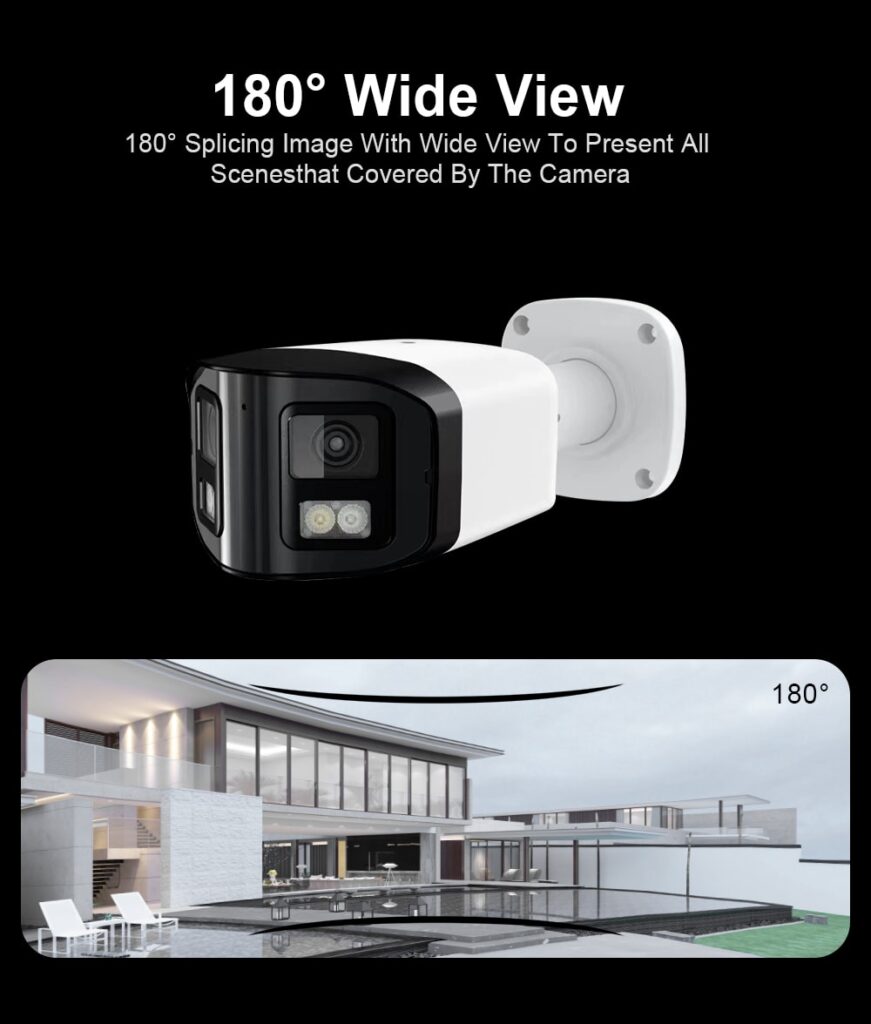
“More” is the wrong question—or at least an incomplete one. A 180° fisheye lens captures more area than a 110° lens, but it does not necessarily capture more useful information at the entrance. At a doorway, the camera’s job is not to maximize pixels devoted to walls, ceiling, and pavement. It is to make the face at the threshold identifiable, the package on the step visible, and the approach from the street legible—simultaneously, under real lighting, at the distances people actually stand. On that test, the wider lens does not automatically win. It wins only when the entrance geometry makes the narrower lens fail.
The Geometry That Decides the Comparison Before the Lens Does
Field of view and focal length are inversely related: a shorter focal length produces a wider view and covers more area at close range; a longer focal length narrows the view but magnifies detail at distance. In practical terms, on a 1/3″ sensor, a 2.8mm lens delivers roughly 100° of view and suits close-range, large-area coverage; a 4mm lens delivers roughly 78° and is the common choice for unit doors and ordinary corridors, balancing view and face size at 5–10 meters; a 6mm lens narrows further to about 50° and is used where faces or plates must be read at 10–20 meters. These are not arbitrary preferences. They are the consequences of how much of the scene must be compressed into a fixed sensor at a given working distance.
The variable that actually separates a wide-angle success from a wide-angle failure is the working distance between the camera and the standing visitor, combined with what else must share the frame. A visitor at 0.5–1.5 meters from the lens occupies a very different share of the sensor than a visitor at 4 meters. A wide lens that is comfortable on a long approach can make a close-standing visitor’s face small and distorted at the frame edge; a standard lens that renders a close face cleanly can lose the approach path entirely on a deep porch. The entrance geometry sets the constraint before the specification sheet is opened.
What the Wide-Angle Lens Actually Delivers—and What It Costs
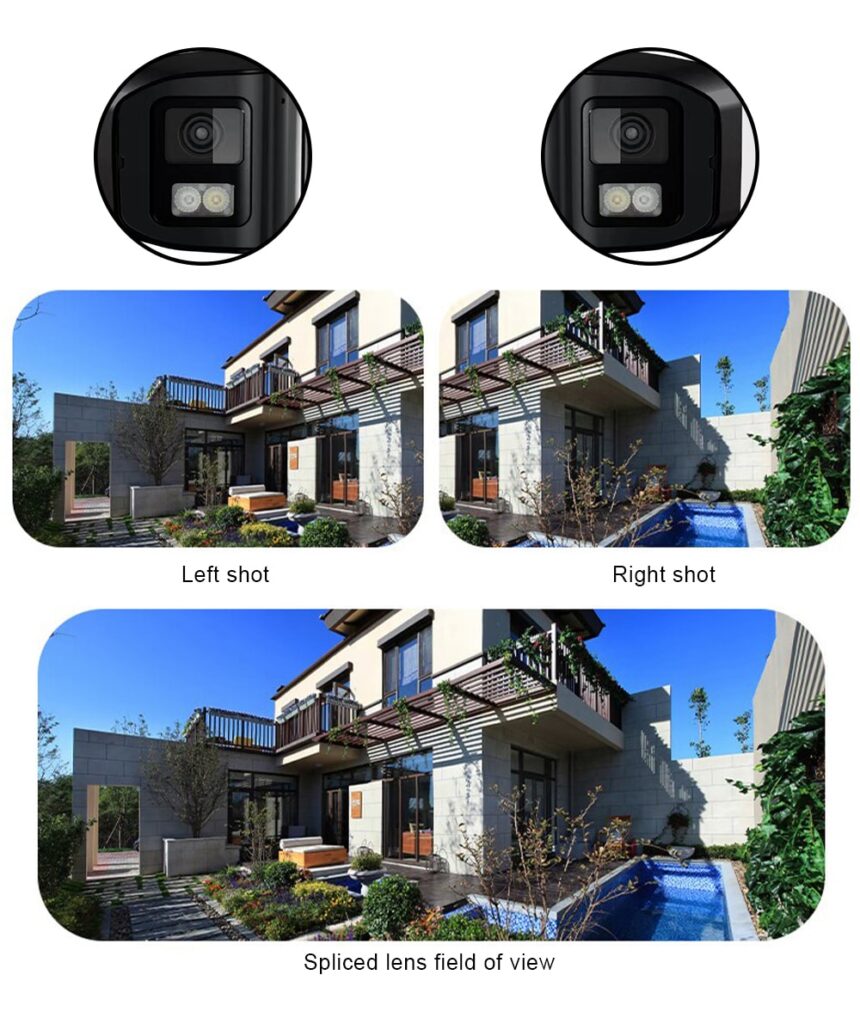
The case for wide-angle is strongest at entrances where a single fixed camera must hold several zones at once. At the near end, vertical coverage matters more than horizontal coverage: a camera that frames the visitor’s face but not the doorstep has not solved the entrance problem, it has moved the blind spot to the floor. A square or portrait aspect ratio, paired with a sufficiently wide vertical field of view, is often more useful than a cinematic horizontal sweep, because it can hold a face and a package in the same frame without extreme wide-angle optics. Some door stations now pair a main wide camera with a dedicated downward-facing second camera specifically to close the near-ground blind spot—an architectural admission that a single wide lens, however wide, cannot always satisfy both the face-framing and package-visibility jobs at once.
The cost of going wider is not a myth, and it is not limited to aesthetics. Beyond roughly 150–160° horizontal, edge distortion becomes functionally significant: faces at the periphery begin to stretch and deform, and the farther a feature sits from the optical axis, the harder it is for both human review and AI face recognition to use it reliably. Lens manufacturers converge on the same range: 150°–160° is described as the “best balance” for most doorbells, while angles beyond 170° produce “obvious fisheye effect” and heavy barrel distortion. A 180° lens that renders a face at the frame edge like a funhouse mirror has not improved identification; it has traded identification quality for coverage that may not be operationally usable.
There is also a resolution penalty that specification sheets rarely surface directly. The sensor’s pixels are distributed across the field of view. As the lens widens, each degree of the scene receives fewer pixels, so a face that occupies a comfortable share of the frame at 120° may occupy a marginal share at 170°. At the same time, barrel distortion displaces features laterally, and the effective identification distance at the edge of a wide-angle frame is shorter than the center—by a substantial margin in quantitative terms. The wide lens sees more, but it does not see the same thing equally well everywhere.
What the Standard Lens Actually Delivers—and Where It Fails
The standard lens—roughly 78° to 115° horizontal in the video intercom context—is not a “narrow” lens in any absolute sense. It is narrower than a fisheye, but it still covers a doorway and a person standing in it at conversational distance. Syhometech’s own villa and door station products use 110°–115° wide-angle cameras, which sit in this standard-wide band rather than at the fisheye extreme; the stated purpose is to see “every visitor clearly—from facial features to the package they are holding”. That is a deliberate trade: enough coverage to include a package in the lower frame, without pushing the face to the distorted periphery.
The standard lens’s advantage is face fidelity at the threshold. With less barrel distortion and a larger share of the sensor devoted to the central subject, a visitor standing where visitors actually stand—directly in front of the call button—renders with natural proportions and enough pixel density for identification. For a single-family villa entrance or a recessed door where the visitor’s standing position is predictable and close, this is often the more useful optical choice, not the compromised one.
The standard lens fails in two predictable geometries. The first is the narrow corridor: with object distance small relative to focal length, a standard wide-angle lens can produce severe barrel distortion precisely because the subject is so close. In that setting, “standard” does not mean distortion-free; it means the distortion is happening at a shorter working distance where it is harder to correct by framing. The second is the deep approach: where the entrance sits at the end of a long path, a standard lens may capture the person at the door but lose the context of who is approaching and from where—context that a wider lens, or a second camera, can provide.
The Middle Ground That Resolves Most Entrances
The practical consensus across installation guidance and lens design is not “wide versus standard” but a band: 150°–160° horizontal is the sweet spot for most apartment and door applications, offering balanced view and low distortion, while 120°–140° suits villas and open porches where the face is close and natural rendering matters more than maximum coverage. Below that band, coverage may be insufficient for the entrance’s geometry; above it, edge distortion and pixel dilution begin to erode the very identification the camera exists to support. A 160° horizontal field of view is a reasonable upper bound for general entrance use—wide enough to capture a visitor and a package on a doorstep in a typical layout, without the fisheye penalty that begins to dominate beyond it.
This is also why the “which captures more” framing misleads. A 150°–160° lens captures less total area than a 180° fisheye, but it captures more usable area for the entrance’s actual tasks. The additional degrees of a fisheye are often spent on wall, ceiling, and pavement that no one needs to identify—and the price is paid in the central face that does need to be identified.
Correction Technology Changes the Boundary, Not the Principle
Modern video intercoms increasingly pair wide optics with distortion correction—optical pre-correction through aspheric elements, ISP-based geometric dewarping, or AI-driven image enhancement that straightens edge geometry before the image reaches the viewer or the recognition engine. This shifts the practical limit: a corrected 160° lens performs more like an uncorrected 130° lens in the central region, and a well-corrected wide camera can avoid the funhouse-mirror failure that defined earlier generations.
But correction does not create information that was never captured. Dewarping redistributes pixels; it does not increase the pixel density devoted to a face at the edge of the frame. A corrected wide lens is still a wide lens, with the same fundamental trade between coverage and per-degree resolution. The correction determines whether the wide lens is usable; the geometry still determines whether it is the right lens for the entrance.
A Decision Framework by Entrance Type
The lens choice should follow from the entrance, not precede it. For a standard apartment door with a visitor standing directly in front at conversational distance, a 150°–160° horizontal lens with distortion correction is the default: wide enough to hold the face and the package, narrow enough to keep the face out of the distorted periphery. For a villa or open porch where the visitor stands close and the priority is natural face rendering, a 110°–140° lens is often the better fit; the entrance does not require fisheye coverage, and the standard-wide lens delivers cleaner identification at the standing position. For a narrow corridor or a recessed vestibule, the working distance is compressed and the wide lens is doing more of the compositional work; here, the 160° end of the band, or a dual-camera arrangement with a downward secondary lens, is more likely to avoid the near-field blind spot that a standard lens cannot escape. For a deep approach or a gate at the end of a path, the entrance has two zones—the threshold and the approach—and a single lens will compromise one of them; the honest solution is either a wider corrected lens that holds both at reduced per-zone fidelity, or a second camera or detection layer that covers the zone the main lens deprioritizes.
The lens that “captures more” at your entrance is not the one with the largest number in the field-of-view column. It is the one whose coverage matches the entrance’s geometry, whose distortion profile keeps the standing visitor’s face inside the usable region of the frame, and whose vertical field of view includes the ground where the package actually sits. For most entrances, that lands in the 150°–160° band—wide enough to matter, narrow enough to still identify the person the system was installed to see.

About the Author: S & Y Internet Technology Inc.
S & Y Internet Technology Inc. is a professional installation and repair service provider based in Flushing, New York. Our expert team provides door-to-door installation and maintenance within a 100 km radius, ensuring quick response and high-quality results for every project — whether residential, commercial, or specialized.

Install & Repair Services
You May Also Interest
-
Video Intercom Camera Angle and Installation Height: How to Eliminate Blind Spots at Your Entrance
A video intercom that captures a visitor’s face but misses the package at their feet has not eliminated blind spots—it has relocated them. The same is true of a camera mounted high enough to survey the approach but too high to identify who is standing at the door, or a wide-angle lens that sees everything…
-
Multi-Language Video Intercom Interfaces: Why Global Buildings Need Localized Apps
A video intercom screen that displays a language menu is not the same thing as a localized intercom experience. The distinction matters more now than at any previous point in the category’s history—because the center of gravity in video intercom interaction has shifted from the wall-mounted indoor monitor to the resident’s phone. For a global…
-
Video Intercom Access Card Cloning Risks: How to Secure RFID and NFC Credentials
Video intercom systems sit at the physical perimeter of a building, and the credential presented at that perimeter is often the weakest link in the chain. A cloned card—duplicated in seconds with commercially available hardware—turns a video intercom into a liability rather than a safeguard. The risk is not theoretical: security researchers have repeatedly demonstrated…
-
Wireless Home Perimeter Camera System Connecticut for DIY-Friendly Setup
A well-designed wireless home perimeter camera system in Connecticut gives you eyes on every side of your property without tearing up walls or running long cables. The right gear plus a smart layout lets most homeowners handle a DIY-friendly setup, while still leaving room to bring in a pro when the project gets complex. If…