2-Wire vs 4-Wire Video Intercom: Which Wiring System Is Right for Your Building?
Share
Quick Navigation
- What Is a 2-Wire Video Intercom System?
- What Is a 4-Wire Video Intercom System?
- The Core Differences: 2-Wire vs 4-Wire
- Side-by-Side Comparison
- When to Choose a 2-Wire System
- When to Choose a 4-Wire System
- The 2-Wire IP Hybrid: The Best of Both Worlds
- Why FARHD Is a Trusted Partner for Both Solutions
- Frequently Asked Questions
When upgrading or installing a video intercom system in a multifamily building, one of the most critical decisions you’ll face is which wiring system to choose. The two most common wired options are 2-wire and 4-wire systems—and the choice between them can significantly impact your installation costs, system performance, and long-term scalability.
In retrofit intercom projects, the biggest challenge is rarely the devices themselves—it’s the existing wiring infrastructure. Choosing between 2-wire, 4-wire, and IP-based systems directly impacts installation cost, system performance, and long-term scalability.
This guide breaks down the differences between 2-wire and 4-wire video intercom systems, helping you make an informed decision for your building.
What Is a 2-Wire Video Intercom System?
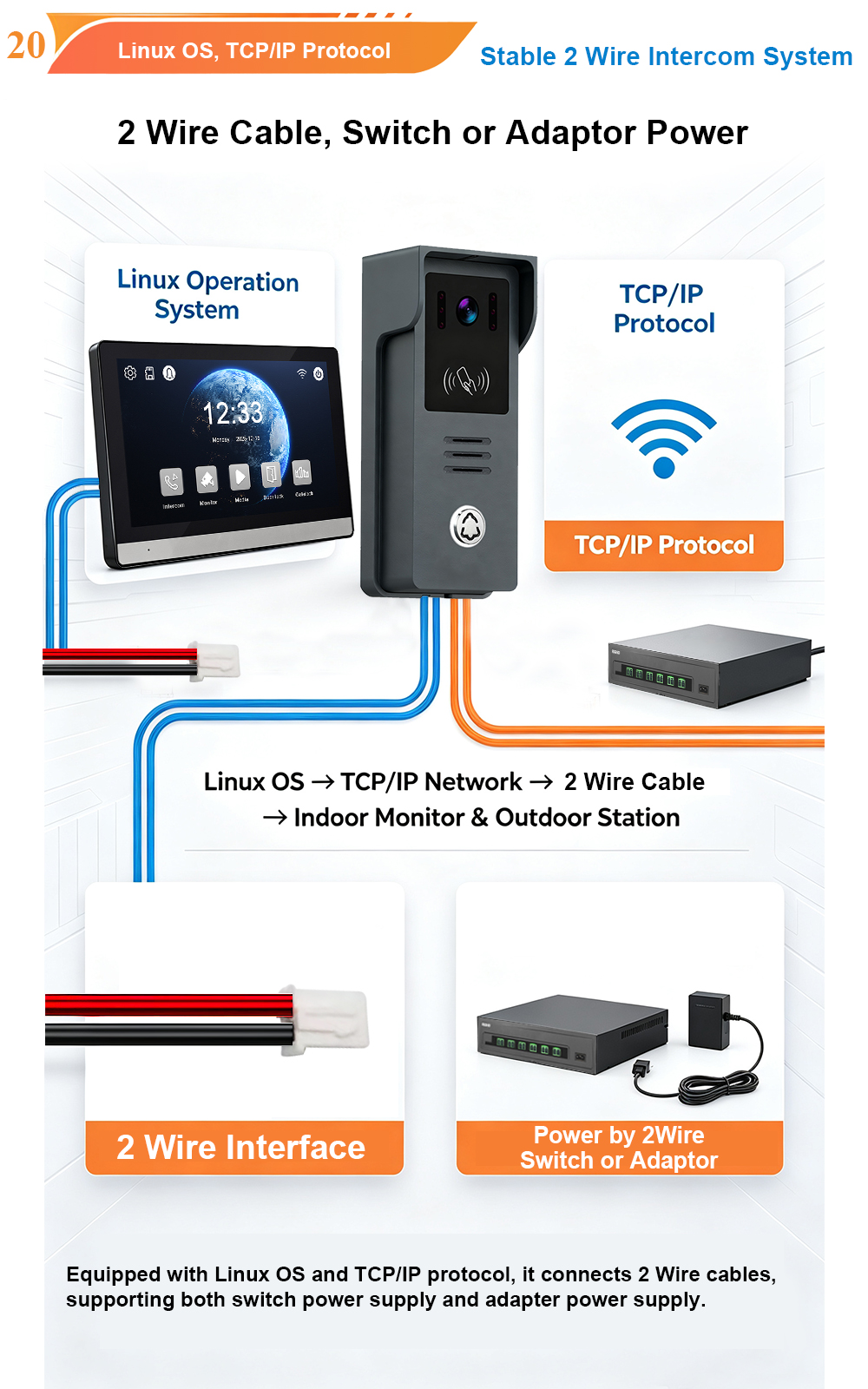
A 2-wire video intercom system is a communication solution that uses just two wires to transmit both power and signals—audio, video, and control data—between the outdoor door station and the indoor monitors.
In a 2-wire system, one wire handles audio and video signals, while the other wire handles power. Through advanced multiplexing techniques and electronic filters, the system keeps different types of signals separate without interference.
Key components of a 2-wire intercom system:
- Master station – Installed at the building entrance with a directory for visitors to select residents
- Base station – Installed in each resident’s unit for conversation and door release
- Door release – Electronically disengages the lock when the resident grants entry
While original 2-wire intercom systems only had audio capabilities, today’s 2-wire systems can use the same wiring to transport HD video and grant access to mobile app features. Modern 2-wire IP systems transmit both power and data over a single pair of wires, allowing legacy cabling to be reused without extensive reconstruction.
What Is a 4-Wire Video Intercom System?
A 4-wire video intercom system uses four wires to establish communication—typically separating power from signal transmission.
In a 4-wire system, two wires are connected to the power supply, and two signal wires are connected to the programmable logic controller (PLC). Because of these extra wires, the paths are different for transmitting and receiving messages: one wire allows you to talk, while the other allows you to listen.
4-wire systems represent a long-standing industry standard for analog intercoms. They separate audio and power transmission, offering stable, reliable communication. The 4-wire system is known for its audio quality and reliability—it is less susceptible to interference and offers a more stable connection compared to some wireless options.
Key characteristics:
- Primarily analog
- Minimal support for video or remote access
- Difficult to expand or integrate
- Today typically maintained only in budget-sensitive upgrades or partial system replacements
The Core Differences: 2-Wire vs 4-Wire
How Many Wires Are Needed?
The most obvious difference is the number of wires, but this has deeper implications:
| Aspect | 2-Wire System | 4-Wire System |
|---|---|---|
| Wire count | 2 wires total | 4 wires total |
| Power | Same wires as signal | Separate wires |
| Signal | Same wires as power | Separate wires |
| Communication | Half-duplex (one at a time) typically | Full-duplex (simultaneous talk/listen) |
Full-Duplex vs Half-Duplex
Four-wire intercom stations can operate in full-duplex mode (simultaneous talk and listen), whereas two-wire intercoms typically operate in half-duplex mode (one speaker at a time). This is because 4-wire systems have separate paths for transmitting and receiving audio.
Installation Complexity
2-wire systems are significantly easier and quicker to install. With fewer wires to manage, installation time is reduced, labor costs are lower, and maintenance is simpler.
Key insight from an industry expert: “Compared to the more complex 4-wire systems, the 2-wire option reduces installation time, lowers costs, and simplifies maintenance, making it an ideal choice for apartments and other business environments”.
Video Quality and Features
While 4-wire systems traditionally offer more stable analog video, modern 2-wire IP systems have closed the gap significantly. Today’s 2-wire systems support HD video, mobile app access, and centralized management, bridging the gap between legacy infrastructure and smart technology.
Scalability
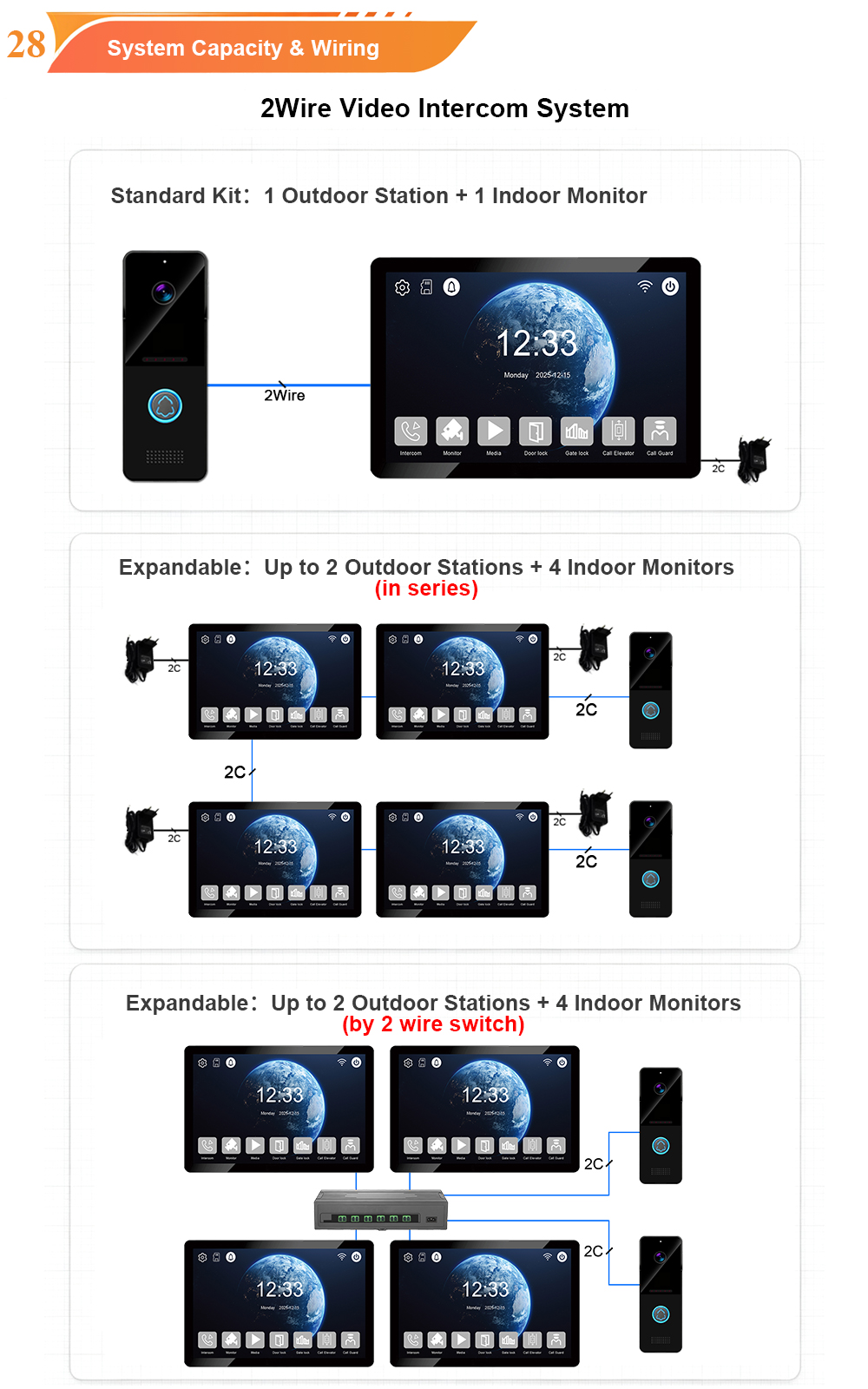
2-wire systems—especially 2-wire IP systems—are more scalable. IP-based systems (2-wire and Cat5/6) support expansion and integration, while 4-wire systems are largely static.
Side-by-Side Comparison
When to Choose a 2-Wire System
✅ You’re Retrofitting an Older Building
If your building already has 2-wire intercom cabling in place, a 2-wire system allows you to upgrade to modern features—including HD video and mobile app access—without pulling new cables.
A 2-wire IP intercom transmits both power and data over a single pair of wires, allowing legacy cabling to be reused without extensive reconstruction. This makes it particularly valuable in older residential buildings and renovation projects where rewiring is costly or impractical.
✅ Minimizing Disruption Is a Priority
In occupied buildings, tearing open walls to run new cables is disruptive and expensive. 2-wire retrofit kits can often reuse existing cabling and wall locations, delivering a faster upgrade path.
✅ Budget Is a Primary Concern
2-wire systems are typically the most cost-effective for retrofits. They reduce installation time, lower costs, and simplify maintenance.
✅ You Want Modern Features Without Full Rewiring
Modern 2-wire systems still support HD video, mobile app access, and centralized management, bridging the gap between legacy infrastructure and smart technology.
✅ Your Building Has Usable Existing Wiring
For aging infrastructure, 2-wire IP intercom systems offer the most efficient upgrade path—minimizing disruption while enabling modern features.
When to Choose a 4-Wire System
✅ You Have Existing 4-Wire Infrastructure
If your building already has 4-wire cabling and you want a simple, low-cost replacement, a 4-wire system can reuse that infrastructure.
✅ You Need Basic, Reliable Communication
4-wire systems are known for their audio quality and reliability—they are less susceptible to interference and offer a more stable connection. For buildings that only need basic audio or low-resolution video, 4-wire may suffice.
✅ You’re Doing a Budget-Sensitive Partial Upgrade
4-wire systems are typically maintained only in budget-sensitive upgrades or partial system replacements.
⚠️ Important Consideration
4-wire systems are becoming obsolete. Many analog intercoms installed over the past two decades are approaching the end of their operational lifespan. They struggle to satisfy today’s expectations for convenience, flexibility, and security. While maintaining a 4-wire system may reduce short-term costs, transitioning to IP-based solutions is generally recommended for long-term viability.
The 2-Wire IP Hybrid: The Best of Both Worlds
One of the most exciting developments in the intercom industry is the 2-wire IP hybrid system—a solution that combines the best of both worlds.
A 2-wire IP intercom system combines modern IP-based communication with legacy two-core wiring. Instead of installing new Ethernet cables to every apartment, the system reuses existing intercom wiring while delivering digital audio, video, and network connectivity.
Key advantages:
- No new cabling needed – reuses existing 2-wire infrastructure
- Full HD video quality – modern 2MP cameras with wide-angle views
- Mobile app access – answer calls, unlock doors from anywhere
- Scalability – can support multiple units and buildings
- Centralized management – batch issuance of permissions, card management, and more
A 2-wire IP network adaptor provides a convenient way to upgrade analog intercom systems without the need for rewiring. This approach is particularly valuable for apartment retrofits in older buildings where installing new Ethernet cabling is too difficult or expensive.
What needs checking before scoping a retrofit:
- Cable condition (older runs may have corrosion or cuts)
- Distances against the kit’s published limits
- Power requirements at the door station and the response point
- Door hardware compatibility with the new strike or maglock
Key insight: “If the door station is dated but the cable is usable, a 2-wire retrofit often lands video and mobile answering without re-cabling”.
Why FARHD Is a Trusted Partner for Both Solutions
With over 28 years of industry experience, FARHD is a leading Chinese manufacturer of video door phones and intercom systems—offering both 2-wire and 4-wire solutions to meet the diverse needs of multifamily properties worldwide.
Full In-House R&D and Production: FARHD designs and manufactures everything from TFT LCD screens, driver boards, and camera modules to complete villa and apartment building intercom systems. This end-to-end control ensures quality and seamless integration at every stage.
Comprehensive Product Range:
- Wireless video doorbells
- 4-wire CVBS and AHD video doorbells
- 2-wire IP systems for villas and apartments
- IP-based systems for villas and apartments
- Audio intercom systems
This means FARHD can provide the right solution for any building situation—whether you need a low-disruption 2-wire retrofit for an existing building or a full-scale 4-wire installation for a cost-sensitive project.
Proven Track Record: FARHD has successfully completed over 10,000 large-scale building video intercom projects, including ultra-large communities with 1,000, 3,000, and even over 5,000 households. Supported by 28 direct sales branches across China, they have the expertise to handle projects of any scale.
Global Reach: FARHD provides SKD semi-knocked-down solutions to assembly factories across Europe, the Middle East, South America, Southeast Asia, the United States, Russia, India, Iran, Turkey, South Korea, and Italy—effectively reducing both production and tariff costs for partners.
International Certifications: Products hold CE, FCC, RoHS, IP65 water resistance, and EMC certifications.
OEM/ODM Services: Comprehensive customization including software and hardware development, UI design, functional module adjustments, and tailored packaging solutions.
After-Sales Support: A dedicated technical support group is established upon product delivery to assist with programming, device installation, and wiring connections throughout the process.
Scale: FARHD serves over 1,000 enterprises worldwide with an annual sales volume of 300,000 units.
Frequently Asked Questions
What’s the main difference between 2-wire and 4-wire intercoms?
In a 4-wire system, two wires are connected to the power supply and two to signal, separating power from communication. In a 2-wire system, one wire handles audio/video signals and the other handles power. This means 4-wire systems can support full-duplex communication, while 2-wire systems typically support half-duplex.
Which system is cheaper to install?
2-wire systems are typically cheaper to install because they use less cable and require less labor. Compared to more complex 4-wire systems, the 2-wire option reduces installation time, lowers costs, and simplifies maintenance.
Can I upgrade from 4-wire to 2-wire without rewiring?
Yes—if the existing cabling is in good condition. A 2-wire retrofit can often reuse existing cabling and wall locations, delivering a faster upgrade path. A 2-wire IP network adaptor provides a convenient way to upgrade analog intercom systems without rewiring.
Which system has better video quality?
Modern 2-wire IP systems can deliver HD video quality, while traditional 4-wire analog systems are typically limited to 720p. The choice depends on whether you’re using a modern 2-wire IP system or a legacy 4-wire analog system.
Which system is more reliable?
Both are reliable as wired systems. 4-wire systems are known for their stability and are less susceptible to interference. However, modern 2-wire IP systems offer comparable reliability with additional smart features.
Which system should I choose for a retrofit?
For aging infrastructure, 2-wire IP intercom systems offer the most efficient upgrade path—minimizing disruption while enabling modern features. If the existing cabling is in good condition, 2-wire retrofits can land video and mobile answering without re-cabling.
How many wires does an intercom system need?
It depends on the system. A 2-wire intercom uses two wires; a 4-wire system uses four; and IP systems use Cat5e/Cat6 Ethernet (8 wires). The number of wires can be as few as two and as many as eight.
Conclusion
Choosing between 2-wire and 4-wire video intercom systems depends on your building’s specific situation.
2-wire systems are typically the most cost-effective for retrofits, offering a strong balance between capability and simplicity. 4-wire systems are suitable for short-term or legacy continuity.
An intercom system is no longer just a communication tool—it is part of a broader access control and smart building ecosystem. Choosing the right wiring solution today determines:
- How easily your system integrates with mobile apps and cloud platforms
- Whether it supports future upgrades and expansions
- The overall lifecycle cost of the system
The global video intercom market continues to evolve, and the trend is clearly toward IP-based systems. Buildings that invest in modern 2-wire IP or full IP solutions now will gain a competitive advantage; those that stick with legacy 4-wire analog systems risk being left behind.
Ready to choose the right wiring system for your building? Contact FARHD for a customized video intercom solution tailored to your property’s existing infrastructure, size, and needs.
This guide is brought to you by FARHD—your partner in smart video intercom solutions for multifamily properties worldwide.

About the Author: S & Y Internet Technology Inc.
S & Y Internet Technology Inc. is a professional installation and repair service provider based in Flushing, New York. Our expert team provides door-to-door installation and maintenance within a 100 km radius, ensuring quick response and high-quality results for every project — whether residential, commercial, or specialized.

Install & Repair Services
You May Also Interest
-

RFID vs QR Code vs Mobile App: Comparing Access Methods for Residential Buildings
Choosing the right access method for your apartment building or gated community is a decision that affects security, convenience, cost, and resident satisfaction. RFID cards, QR codes, and mobile apps each have distinct strengths and weaknesses. This guide compares them side by side—so you can make an informed choice for your next project. In modern…
-
Tuya vs Smart Life: Which App Is Better for Your Video Door Phone?
A practical comparison to help you choose the right app for your smart intercom system If you’ve recently purchased a FARHD video door phone, you’ve probably noticed that the product documentation mentions two apps: Tuya Smart and Smart Life. This immediately raises a common question: which one should you actually use? Are they different? Does…
-

Touch Screen vs Non-Touch Video Intercom Monitors: Which Is Better for Residents?
When specifying a video intercom system for an apartment building, villa, or residential community, one question often divides decision-makers: should the indoor monitor have a touch screen or physical buttons? Both options have passionate advocates. Both have real advantages. And both can be the wrong choice if they don’t match the needs of the residents…
-

How to Upgrade an Old Apartment Intercom to IP Without Rewiring: Step-by-Step
Upgrading an old apartment intercom to a modern IP system no longer requires tearing down walls, replacing every cable, or disrupting residents for weeks. With the right retrofit technology, you can deliver full IP functionality—video calling, mobile access, remote management—using the existing 2-wire cabling already inside your building. This step-by-step guide shows you how. Many…