IP Video Door Phone vs 2-Wire Intercom: Which System Is Right for Your Building?
Share
Quick Navigation
- What Is a 2-Wire Intercom System?
- What Is an IP Video Door Phone System?
- 2-Wire vs IP: The Core Difference
- Side-by-Side Comparison
- When to Choose a 2-Wire Intercom System
- When to Choose an IP Video Door Phone System
- 2-Wire IP Hybrid Systems: The Best of Both Worlds
- Real-World Examples
- Why FARHD Is a Trusted Partner for Both Solutions
- Frequently Asked Questions
What Is a 2-Wire Intercom System?
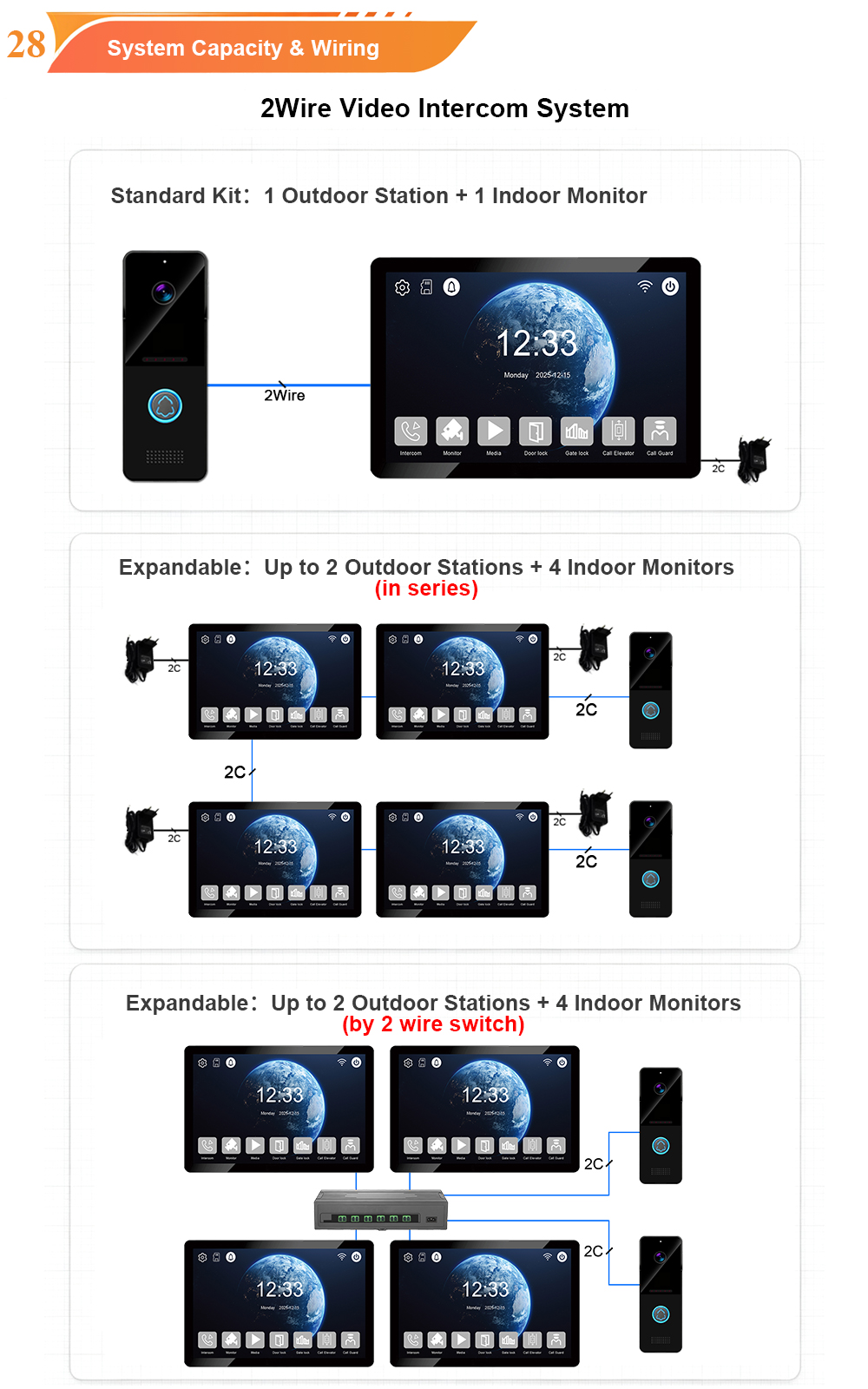
A 2-wire intercom system is a communication system that uses just two physical wires to transmit both power and communication signals—audio, video, and control data—between the outdoor door station and the indoor monitors.
In a traditional 2-wire system, the two wires carry everything: the audio signal so residents can hear and speak with visitors, the video signal (if applicable) from the door camera to the indoor monitor, and the power supply needed to run all devices. This is often achieved through power-over-wire (PoW) technology, which allows the same wiring to carry both power and signals.
Key components of a 2-wire intercom system:
| Component | Function |
|---|---|
| Door Station (Master Station) | Installed at the building entrance with camera, microphone, speaker, and call directory |
| Indoor Monitor (Base Station) | Installed in each apartment; allows residents to see, speak, and unlock |
| Door Release Controller | Electrically unlocks the door when the resident presses the button |
| Power Supply / Distributor | Provides power and manages signal distribution across the system |
How it works: A visitor presses the call button on the outdoor door station. The signal travels over the two wires to the indoor unit, triggering the screen to turn on and alerting the resident. The video feed from the door station camera is transmitted over the same two wires and displayed on the indoor monitor. The resident can hear the visitor, speak back, and—if they choose—unlock the door directly from the indoor unit.
Modern digital 2-wire systems have evolved significantly. Today’s 2-wire technology supports full HD video, mobile app control, and long-distance signal stability without requiring new cabling. Digital 2-wire systems can achieve distances of 150 meters or more, compared to roughly 100 meters for analog versions.
What Is an IP Video Door Phone System?
An IP video door phone system is a “who’s at the door” system that runs over a standard computer network and the internet. You see the visitor on a monitor in your apartment or in an app on your phone, talk to them, and open the door if needed.
Key components of an IP video door phone system:
How it works: When a visitor presses the call button, the door station places a VoIP (Voice over IP) call over the building’s network. The call rings the resident’s indoor monitor and smartphone app simultaneously. The resident answers, sees the visitor in HD video, speaks with them, and unlocks the door with a single tap—whether they’re in the apartment or on the other side of the world.
2-Wire vs IP: The Core Difference
The fundamental distinction comes down to one question: What kind of cable path does your building have?
In practical terms, IP is often the better long-term system architecture, while 2-wire is often the better short-to-medium-term retrofit strategy when the building conditions make that worthwhile.
Here’s the key insight: 2-wire is mostly a retrofit conversation. IP is mostly a new-cable or structured-cabling conversation. Both can deliver a modern intercom experience, but they solve different site problems.
Side-by-Side Comparison
When to Choose a 2-Wire Intercom System
Choose a 2-wire intercom system when:
✅ You’re Retrofitting an Older Building
If your building already has 2-wire intercom cabling in place, a 2-wire system allows you to upgrade to modern features—including video and mobile app access—without pulling new cables.
Why this matters: Upgrading an old intercom system to a conventional IP system typically involves messy and costly rewiring work. 2-wire systems let you reuse existing wiring, keeping installation quick, easy, and cost-effective.
✅ Minimizing Disruption Is a Priority
In occupied buildings, tearing open walls to run new cables is disruptive and expensive. 2-wire retrofit kits can often reuse existing cabling and wall locations, delivering a faster upgrade path.
✅ You Have a Small to Medium Building
2-wire systems are particularly attractive in townhouses, units, and older small buildings where the owner wants modern calling without opening walls. For buildings with fewer than 20–30 units, a well-designed 2-wire system can deliver excellent value.
✅ Budget Is a Primary Concern
2-wire systems offer lower material and labor costs. For a 50-unit apartment building, the difference in cabling costs alone can translate to $2,000–$3,500 in savings. When combined with reduced labor hours, total installation costs decrease by 30–40% versus comparable IP-based alternatives.
The trade-off: You get modern features, but with limitations on scalability, video resolution, and integration capabilities.
When to Choose an IP Video Door Phone System
Choose an IP video door phone system when:
✅ You’re Building New or Re-Cabling
When the building is already open or being cabled, IP gives you the cleaner long-term system architecture and avoids preserving old-style compromises. If Cat6 can be run, choose IP.
✅ You Need Scalability
Adding another entrance, or even an entire building, is straightforward with IP: install an indoor monitor, connect it to the existing building network, link it to the system in the settings—no need to pull new dedicated cables. You can connect dozens of residential buildings in one complex into a single network serving thousands of residents.
✅ You Want Full Integration
Modern IP intercoms work with access control systems, lifts, gates, and barriers. They integrate through open standards like SIP (for voice/video calls), ONVIF Profile T (for video management), and OSDP (for access control). This enables intercoms to function as part of a unified security ecosystem rather than isolated devices.
✅ You Want the Best Video Quality
Today’s IP intercoms offer HD video and audio quality—a dramatic leap from the grainy 0.3-megapixel images of older systems to crisp 2, 5, or even 8-megapixel resolution. This transforms intercoms into effective video surveillance endpoints, capturing clear facial details and clothing descriptions at entry points.
✅ You Want Future-Proof Technology
IP systems are easier to support because installers and IT professionals understand network cabling better than unusual legacy intercom paths. Software updates can add new features over time, keeping your system current without hardware replacement.
The trade-off: Higher upfront costs and the need for network infrastructure.
2-Wire IP Hybrid Systems: The Best of Both Worlds
One of the most exciting developments in the intercom industry is the 2-wire IP hybrid system—a solution that combines the best of both worlds.
A 2-wire IP intercom system combines modern IP-based communication with legacy two-core wiring. Instead of installing new Ethernet cables to every apartment, the system reuses existing intercom wiring while delivering digital audio, video, and network connectivity.
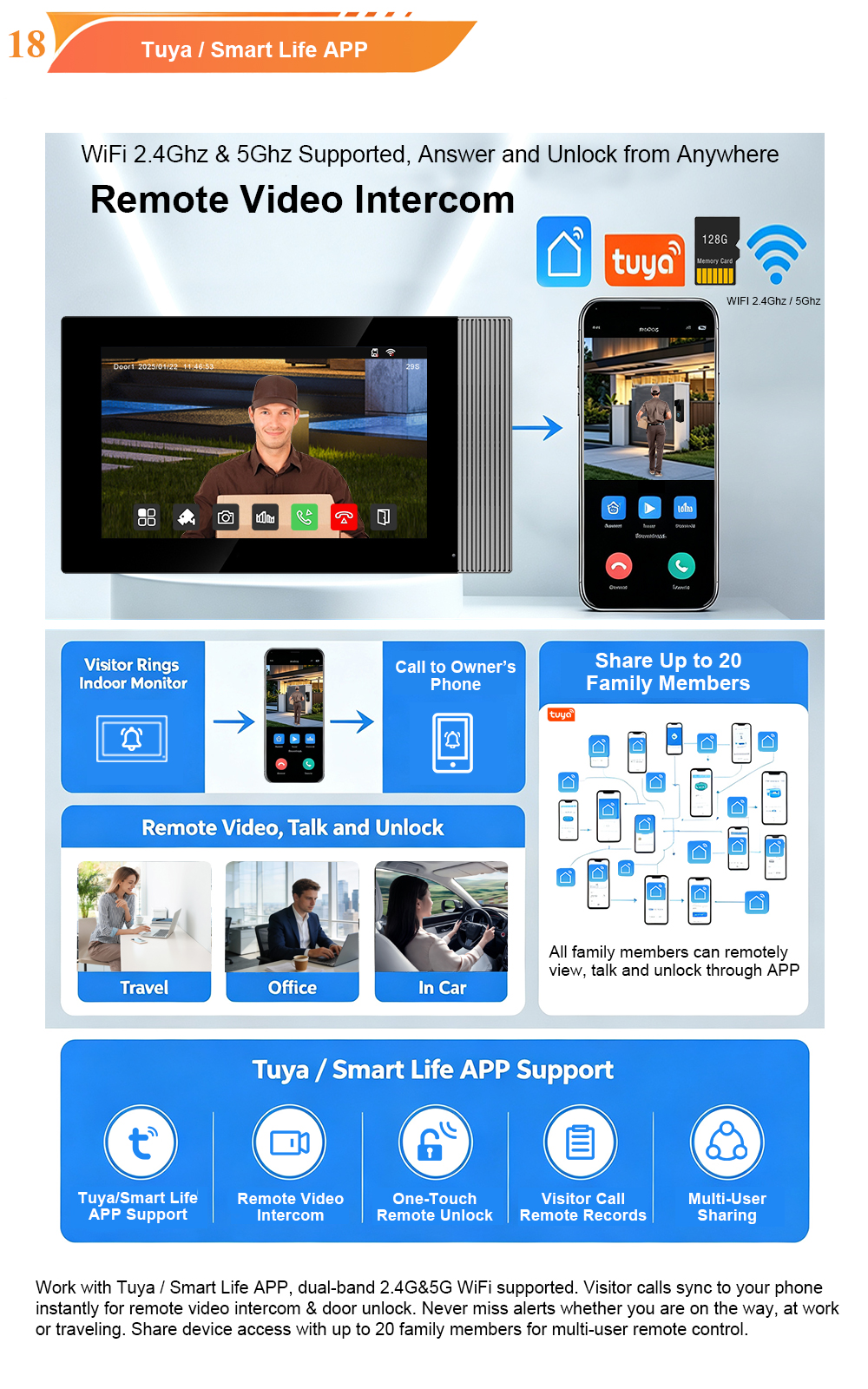
How it works: A 2-wire IP system uses existing two-wire cabling to transmit power and data, but at the core is an intelligent distributor that consolidates power and internet connectivity, enabling it to be distributed to outdoor door stations and indoor video units. The system delivers all the benefits of IP—HD video, mobile app control, remote access—through just two wires.
Key advantages:
- No new cabling needed—reuses existing 2-wire infrastructure
- Full HD video quality—2MP cameras with wide-angle views
- Mobile app access—answer calls, unlock doors from anywhere
- Scalability—can support multiple units and buildings
- Centralized management—batch issuance of permissions, card management, and more
This approach is particularly valuable for apartment retrofits in older buildings where installing new Ethernet cabling is too difficult or expensive.
Real-World Examples
Example 1: The 8-Unit Retrofit
Situation: An old eight-unit block needs to replace a failed panel. The owners do not want major cable work through existing common areas and units, and the building already has an older intercom path in place.
Solution: A 2-wire retrofit. The goal is to restore and modernize the entry with low disruption.
Why this works: The quality of the existing cable route is the deciding factor. If the cable is still viable, a 2-wire solution delivers modern features without opening walls.
Example 2: The 14-Building Complex
Situation: A large apartment complex with 14 high-rise buildings, each with 52 apartments, needs a video intercom to allow tenants to screen visitors. The system must work with existing network infrastructure.
Solution: An IP multi-tenant video intercom. All 14 buildings were outfitted with an IP system, giving tenants and concierge personnel a safe way to identify visitors before unlocking any entrance.
Why this works: The network-based system reused existing infrastructure, saving labor costs, while providing mobile app access for on-the-go tenants.
Example 3: The 48-Unit Building Retrofit
Situation: A housing estate built in 2008 features outdated 2-wire wiring. Two buildings, each with 48 apartments. The previous intercom system was old and unstable.
Solution: A 2-wire IP intercom retrofit. The solution uses existing 2-wire cables, minimizing material and labor costs.
Why this works: By leveraging existing wiring, the installation was simplified, reducing time and disruption to residents. The system is scalable for future expansion.
Why FARHD Is a Trusted Partner for Both Solutions
With over 28 years of industry experience, FARHD is a leading Chinese manufacturer of video door phones and intercom systems—offering both 2-wire and IP solutions to meet the diverse needs of multifamily properties worldwide.
Full In-House R&D and Production: FARHD designs and manufactures everything from TFT LCD screens, driver boards, and camera modules to complete villa and apartment building intercom systems. This end-to-end control ensures quality and seamless integration at every stage.
Comprehensive Product Range:
- Wireless video doorbells
- 4-wire CVBS and AHD video doorbells
- 2-wire IP systems for villas and apartments
- IP-based systems for villas and apartments
- Audio intercom systems
This means FARHD can provide the right solution for any building situation—whether you need a low-disruption 2-wire retrofit or a full-scale IP installation for a new development.
Proven Track Record: FARHD has successfully completed over 10,000 large-scale building video intercom projects, including ultra-large communities with 1,000, 3,000, and even over 5,000 households. Supported by 28 direct sales branches across China, they have the expertise to handle projects of any scale.
Global Reach: FARHD provides SKD semi-knocked-down solutions to assembly factories across Europe, the Middle East, South America, Southeast Asia, the United States, Russia, India, Iran, Turkey, South Korea, and Italy—reducing both production and tariff costs for partners.
International Certifications: Products hold CE, FCC, RoHS, IP65 water resistance, and EMC certifications.
OEM/ODM Services: Comprehensive customization including software and hardware development, UI design, functional module adjustments, and tailored packaging solutions.
After-Sales Support: A dedicated technical support group is established upon product delivery to assist with programming, device installation, and wiring connections throughout the process.
Scale: FARHD serves over 1,000 enterprises worldwide with an annual sales volume of 300,000 units.
Frequently Asked Questions
Can I upgrade my old 2-wire system to IP without rewiring?
Yes. 2-wire IP hybrid systems allow you to reuse existing 2-wire cabling while delivering IP features like HD video, mobile app access, and remote management.
Which system has better video quality?
IP systems offer superior video quality—up to 4K (8 megapixels) compared to 480p–720p for most 2-wire systems. However, modern digital 2-wire systems can deliver HD (1080p) video.
Is a 2-wire system cheaper than IP?
Yes, typically. 2-wire systems offer lower material and labor costs—30–40% less than comparable IP installations. For a 50-unit building, cabling savings alone can be $2,000–$3,500.
Can 2-wire systems support mobile apps?
Modern digital 2-wire systems do support mobile app control—remote answering, live viewing, door unlocking, and push alerts. However, the range of app features may be more limited than full IP systems.
How many units can each system support?
IP systems are more scalable—they can support hundreds or even thousands of units across multiple buildings. 2-wire systems are generally better suited for smaller to medium buildings (under 50–100 units).
What if my building has no existing wiring?
If there’s no existing cabling at all, IP is usually the better choice—you can run Cat6 once and have a future-proof system. 4G/wireless door stations may also be an option for gates or remote entries.
Conclusion
The right system depends on your building—not just the brochure.
The bottom line: If the building is already open or being cabled, IP gives you the cleaner long-term system architecture. If the real project goal is minimizing wall work and preserving the old route, 2-wire is the smarter choice. For buildings in between, a 2-wire IP hybrid system delivers modern IP features through existing wiring—the perfect compromise.
The global video intercom market is growing rapidly—projected to reach $3.2–3.8 billion by 2026—and the shift toward IP-based systems with smartphone connectivity is accelerating. Whether you choose 2-wire, IP, or a hybrid solution, investing in a modern video intercom system is a strategic decision that enhances security, convenience, and property value.
Ready to choose the right system for your building? Contact FARHD for a customized video intercom solution tailored to your property’s cabling, size, and needs.
This guide is brought to you by FARHD—your partner in smart video intercom solutions for multifamily properties worldwide.

About the Author: S & Y Internet Technology Inc.
S & Y Internet Technology Inc. is a professional installation and repair service provider based in Flushing, New York. Our expert team provides door-to-door installation and maintenance within a 100 km radius, ensuring quick response and high-quality results for every project — whether residential, commercial, or specialized.

Install & Repair Services
You May Also Interest
-
RFID vs QR Code vs Mobile App: Comparing Access Methods for Residential Buildings
Choosing the right access method for your apartment building or gated community is a decision that affects security, convenience, cost, and resident satisfaction. RFID cards, QR codes, and mobile apps each have distinct strengths and weaknesses. This guide compares them side by side—so you can make an informed choice for your next project. In modern…
-
Tuya vs Smart Life: Which App Is Better for Your Video Door Phone?
A practical comparison to help you choose the right app for your smart intercom system If you’ve recently purchased a FARHD video door phone, you’ve probably noticed that the product documentation mentions two apps: Tuya Smart and Smart Life. This immediately raises a common question: which one should you actually use? Are they different? Does…
-
Touch Screen vs Non-Touch Video Intercom Monitors: Which Is Better for Residents?
When specifying a video intercom system for an apartment building, villa, or residential community, one question often divides decision-makers: should the indoor monitor have a touch screen or physical buttons? Both options have passionate advocates. Both have real advantages. And both can be the wrong choice if they don’t match the needs of the residents…
-
How to Upgrade an Old Apartment Intercom to IP Without Rewiring: Step-by-Step
Upgrading an old apartment intercom to a modern IP system no longer requires tearing down walls, replacing every cable, or disrupting residents for weeks. With the right retrofit technology, you can deliver full IP functionality—video calling, mobile access, remote management—using the existing 2-wire cabling already inside your building. This step-by-step guide shows you how. Many…